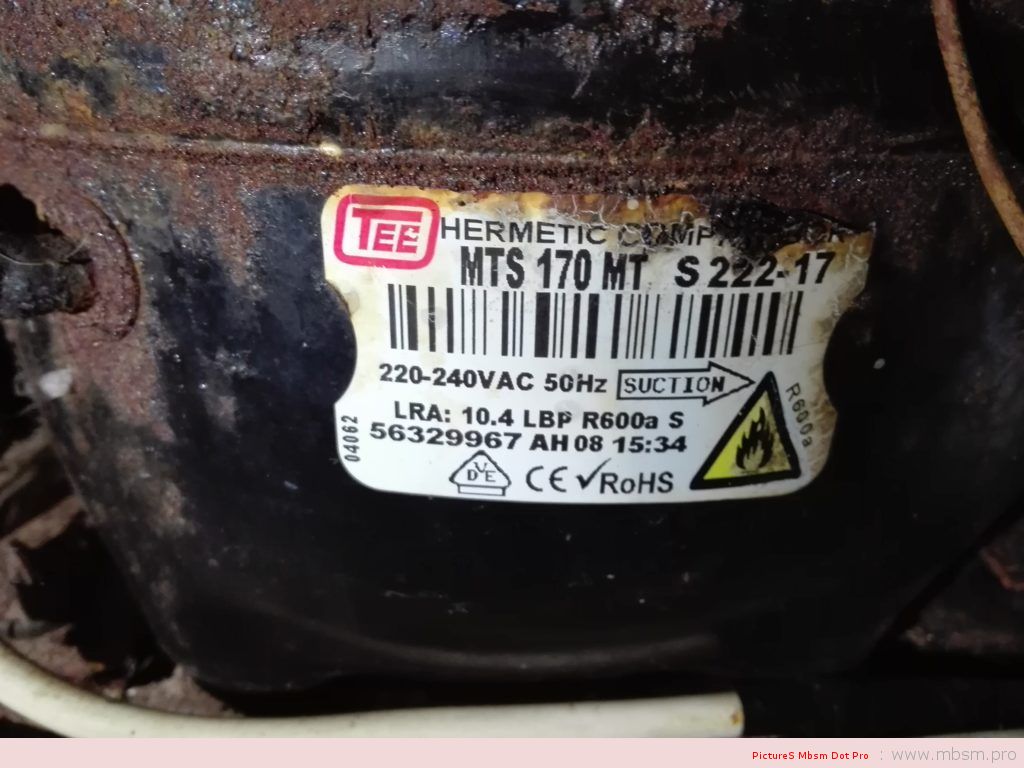
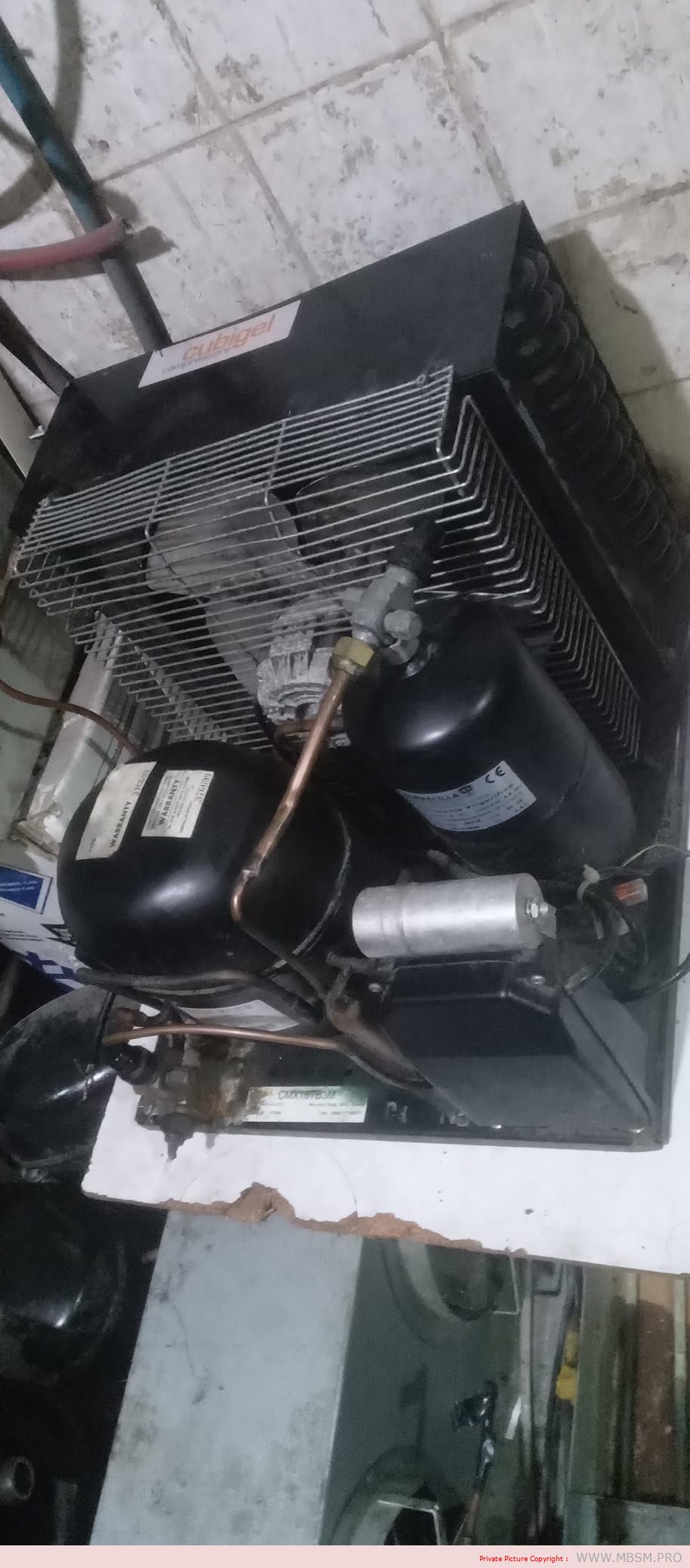
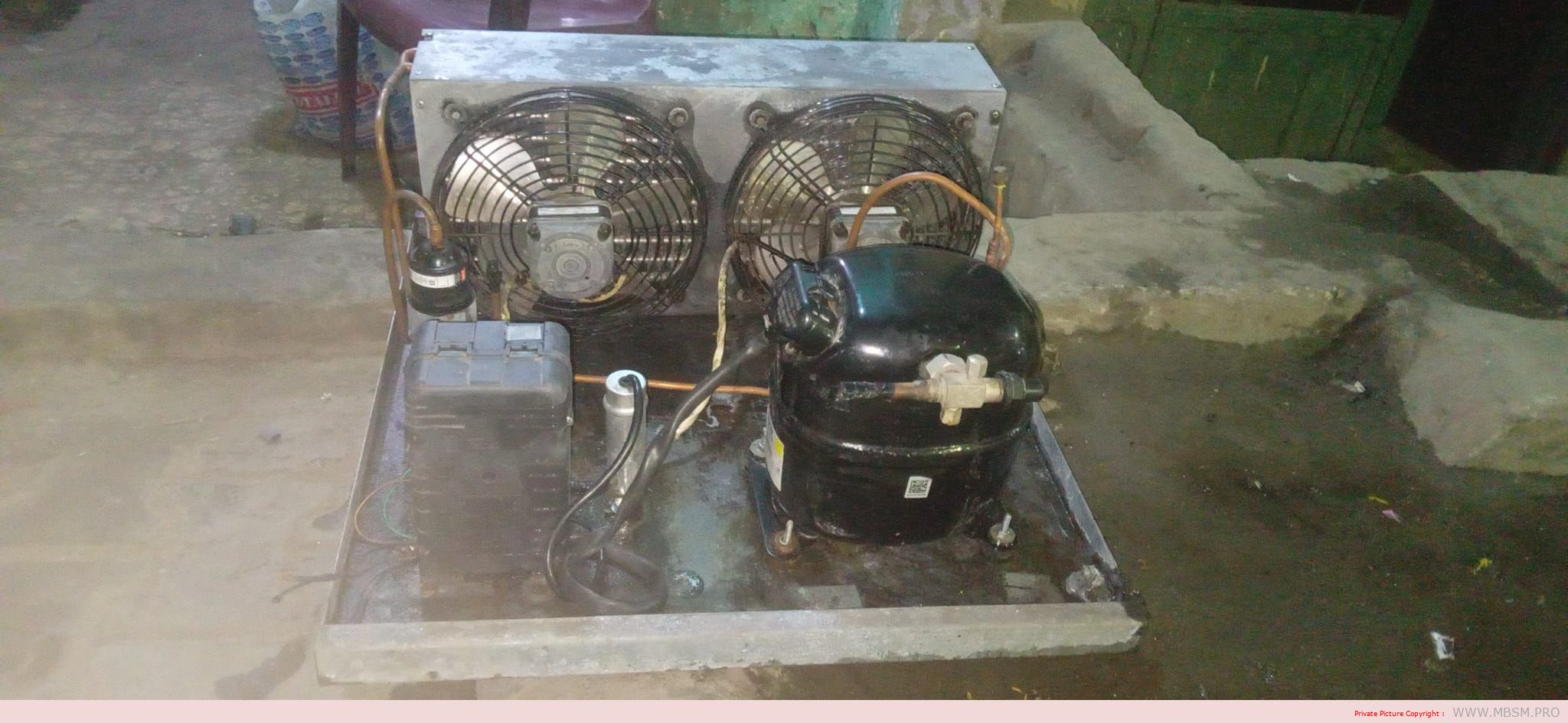
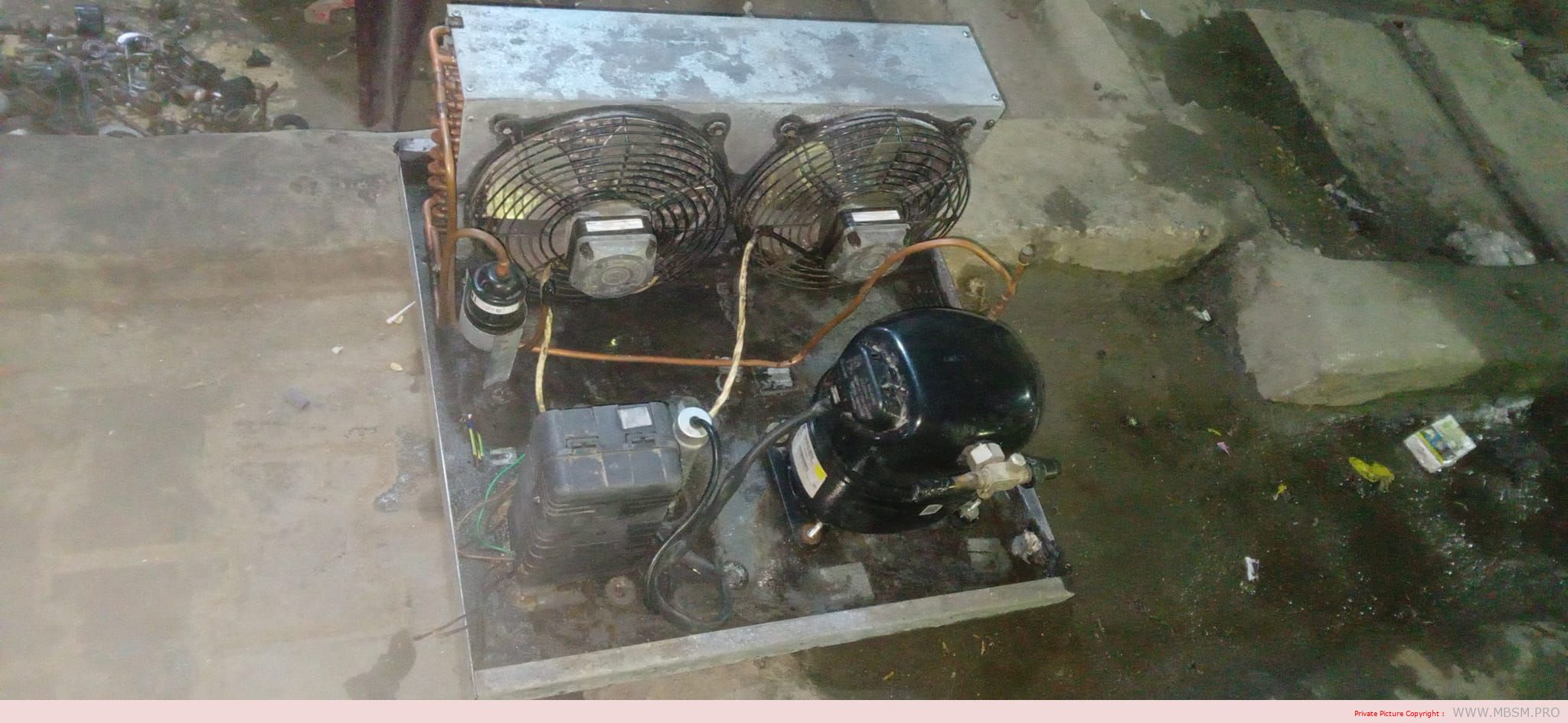
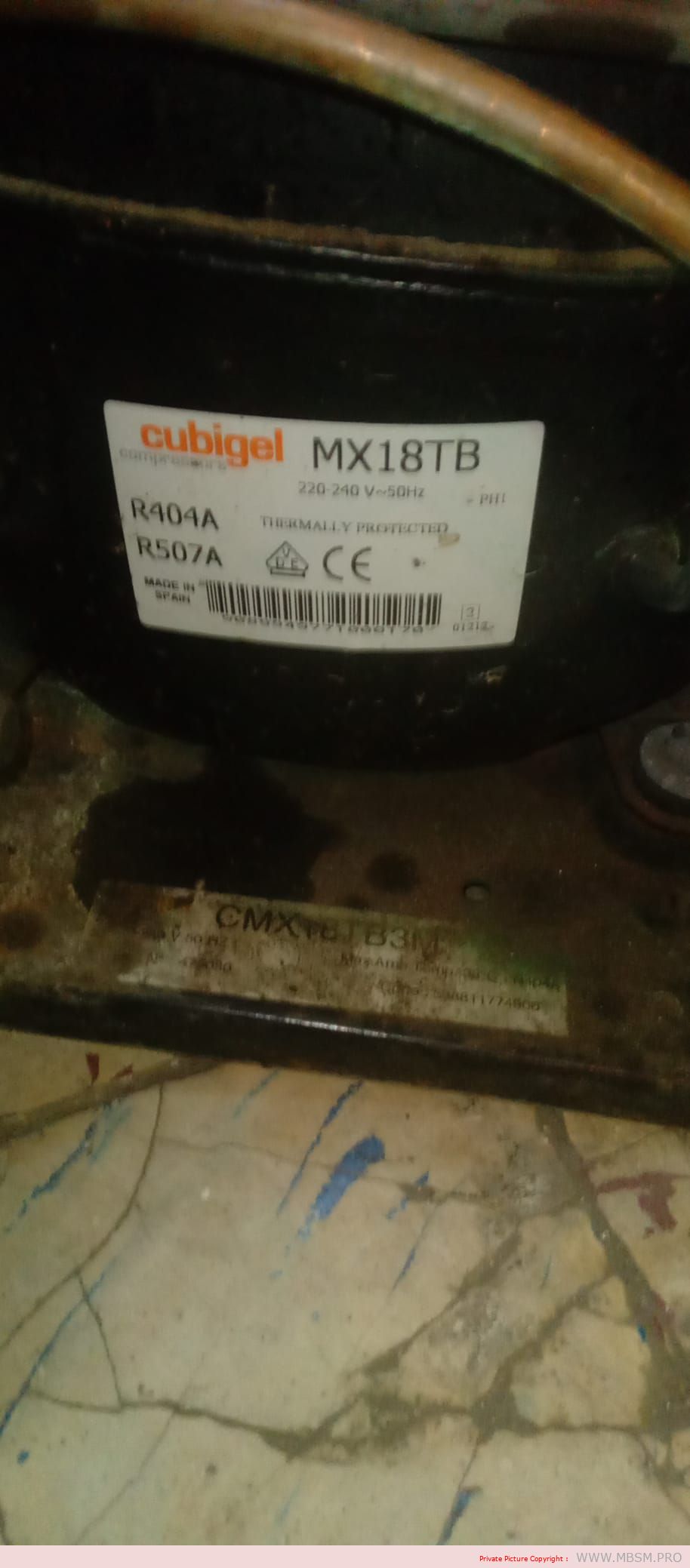
If you’ve ever opened the back panel of a commercial chest freezer or a light commercial display case and found a compact, brushless compressor with a controller module attached to it, there’s a good chance you were looking at a Danfoss Secop SLV15CNK. This variable-speed hermetic compressor is one of the most widely deployed LBP (Low Back Pressure) units in European and international commercial refrigeration — and for good reason.
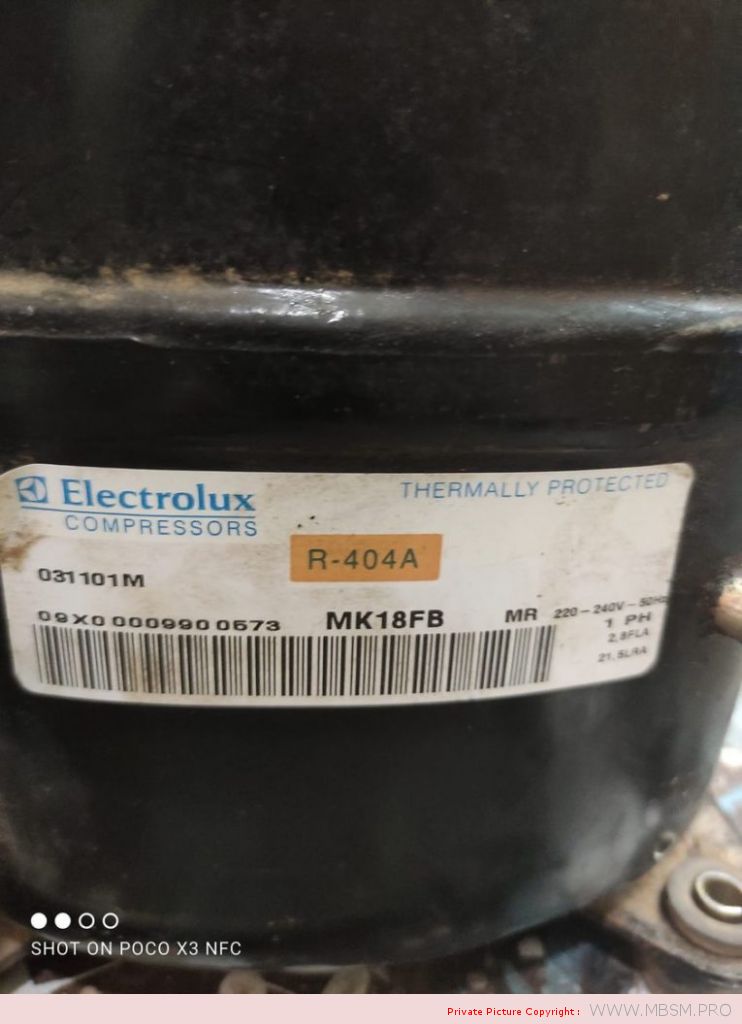
Originally built under the Danfoss brand before the compressor division was spun off as Secop GmbH in 2010, the SLV15CNK has carved out a reliable reputation across commercial food retail, light industrial cooling, and even medical cold-chain applications. The unit pictured above — serial reference 561108N4, profile 104H — is the standard 220–240V, 50/60 Hz variant using R290 (propane) refrigerant, one of the most eco-friendly natural refrigerants available today.
Complete Technical Specifications Table
Parameter
Value
Model
SLV15CNK / SLV15CNK.2
Utilisation (MBP/HBP/LBP)
LBP only (Low Back Pressure)
Domain (Freezing/Cooling)
Deep Freezing — evap. temp. –40°C to –10°C
Cooling Wattage at –23°C
~446 W (nominal at standard LBP conditions)
Cubic Feet Cooled
~7–10 ft³ (small to medium chest freezer)
Litres Cooled
~200–280 litres
Kcal/h
~383 Kcal/h
TON
~0.127 TON of refrigeration
Oil Type & Quantity
Polyolester (POE) — 600 cm³
Horsepower (HP)
5/8 HP (~0.60 HP)
Refrigerant Type
R290 (Propane) — max charge 150 g
Power Supply
220–240V / 1Ph / 50–60 Hz (range: 180–254V)
Cooling Capacity BTU
~1521 BTU/h (LBP nominal)
Motor Type
Permanent Magnet (TRI — 3-phase inverter driven)
Displacement
15.28 cm³
Winding Material
Copper (3-phase windings, resistance ~7.7 Ω at 25°C)
Pression Charge
LBP / LST — max condensing temp 55°C (65°C short-term)
Capillary
Approx. 3m / Ø0.31 mm (application-dependent — verify with OEM data)
–40°C to –10°C evaporating; –35°C practical freezer operation
With Fan or Not
Yes — F2 fan cooling required (3.0 m/s airflow on compressor & controller)
Commercial or Domestic
Commercial (light commercial / food retail)
Amperage in Function
Max 4.6 A
LRA (Locked Rotor Amperage)
Electronic cut-off (no traditional LRA — inverter-controlled)
Type of Relay
No traditional relay — uses 105N46xx Series SLV Electronic Controller
Capacitor
No start/run capacitor — inverter-driven (variable speed 2000–4000 RPM)
Country of Origin & Export
Manufactured in Slovakia (Secop GmbH) — exported globally: EU, UK, Middle East, North Africa, Australia, Asia
What Makes This Compressor Special?
Variable Speed Technology
Most technicians encounter fixed-speed compressors day in and day out. The SLV15CNK breaks that mold entirely. It’s a variable speed drive (VSD) compressor, meaning its speed adapts continuously between 2000 and 4000 RPM based on thermal demand. The result is dramatically reduced energy consumption during low-load periods, less mechanical wear, and quieter operation — all things that matter enormously in a commercial food retail environment where a freezer runs 24/7, 365 days a year.
R290 — The Natural Refrigerant Advantage
R290 (propane) is not new, but its adoption in commercial compressors has accelerated rapidly in recent years thanks to its near-zero Global Warming Potential (GWP = 3) compared to the synthetic alternatives it replaces. The SLV15CNK uses a maximum charge of just 150 grams, which keeps it below the safety threshold for flammable refrigerant use in occupied spaces. That tiny charge, combined with propane’s excellent thermodynamic properties, means this compressor achieves high efficiency with a very light environmental footprint.
The Controller Dependency
One detail technicians absolutely must not overlook: this compressor will not function without its dedicated SLV electronic controller (105N46xx series). The label on the unit itself clearly states “Only with SLV controller.” This is not a traditional hermetic compressor you can simply wire up to a relay and a capacitor. The controller handles speed regulation, current protection, speed monitoring, and thermal protection all in one unit. Replacing or sourcing this controller is as important as finding the compressor itself.
Fan Cooling Is Mandatory
At all ambient conditions (32°C, 38°C, and 43°C), the datasheet specifies F2 cooling — meaning fan airflow of at least 3.0 m/s directly on both the compressor body and the electronic controller unit. Attempting to run this compressor without proper forced airflow will trigger thermal protection and lead to premature failure. This is a common oversight when installers replace the compressor without checking the cabinet’s fan arrangement.
Replacement Compressors — Same Gas (R290)
When the SLV15CNK reaches end of life or fails, the most straightforward replacements use the same R290 refrigerant. Here are five proven options:
#
Replacement Model
Brand
Notes
1
SLV15CNK.2 (104H8541)
Secop/Danfoss
Direct drop-in replacement — latest revision
2
SLV12CNK.2
Secop/Danfoss
Slightly lower displacement, same gas and controller family
3
SLV20CNK.2
Secop/Danfoss
Higher capacity option — same R290/controller platform
4
NLV14CNK
Secop/Danfoss
Fixed-speed variant on R290 LBP — requires relay/capacitor
5
SCM10CNX.2
Secop
R290, standard hermetic, LBP — no inverter controller needed
Replacement Compressors — Different Refrigerant
If R290 is not available in your region, or if you’re retro-fitting an older system, here are five equivalents using alternative refrigerants with comparable capacity:
#
Replacement Model
Brand
Refrigerant
Notes
1
SC15G
Secop/Danfoss
R404A / R507A
Classic LBP hermetic, no controller needed
2
NL11MF
Secop/Danfoss
R134a
LBP/MBP, standard hermetic
3
CAJ9513Z
Embraco
R404A
Direct LBP replacement at similar capacity
4
NEBL2134Z
Embraco
R600a
For domestic/light LBP applications
5
MTZ32-4VM
Danfoss
R452A/R404A
Slightly oversized but compatible for retrofits
⚠️ Important: Switching refrigerants requires changing the oil type, capillary tube, and verifying all safety certifications. Always consult the system manufacturer before cross-refrigerant replacement.
Typical Applications — Which Freezers Use This Compressor?
The SLV15CNK is the heart of many products you’ll recognize from the supermarket floor:
AHT Australian series chest freezers (confirmed via MBSM documentation)
Frozen food display cases at petrol stations and convenience stores
Ice cream chest cabinets in retail environments
The AHT connection is particularly well-documented — AHT is a major manufacturer of commercial freezers widely deployed across European and African retail chains, and the SLV15CNK is one of their standard compressor choices.
Installation & Service Notes
A few practical points every technician should keep in mind when working with this unit:
Controller wiring: Always refer to the 105N46xx wiring diagram. Polarity and signal connections matter — the controller is not interchangeable between all SLV variants.
Refrigerant handling: R290 is flammable (Class A3). Work in ventilated areas, avoid open flames, and use an R290-certified manifold gauge set. The 150g charge limit means leaks are rare but must be taken seriously.
Oil compatibility: POE oil is mandatory with R290 in this application. Do not substitute mineral oil or alkylbenzene — POE is pre-filled at the factory at 600 cm³.
Mounting vibration: The compressor ships with rubber mounting grommets. Always re-use or replace them — running on a hard mount increases noise and mechanical fatigue.
Capillary tube: The reference capillary for AHT applications is approximately 3m / 0.31mm diameter, but always measure and verify against the original system before cutting new tubing.
Why This Compressor Matters in 2025 and Beyond
The refrigeration industry is at a turning point. Synthetic refrigerants with high GWP are being phased out under F-Gas regulations in Europe and similar legislation worldwide. The SLV15CNK — running on propane with a permanent magnet variable-speed motor — represents exactly the direction the industry is heading: natural refrigerants, intelligent speed control, and reduced energy consumption without compromising reliability.
For service technicians, understanding this platform deeply isn’t just useful today — it’s preparation for the next decade of commercial refrigeration work.
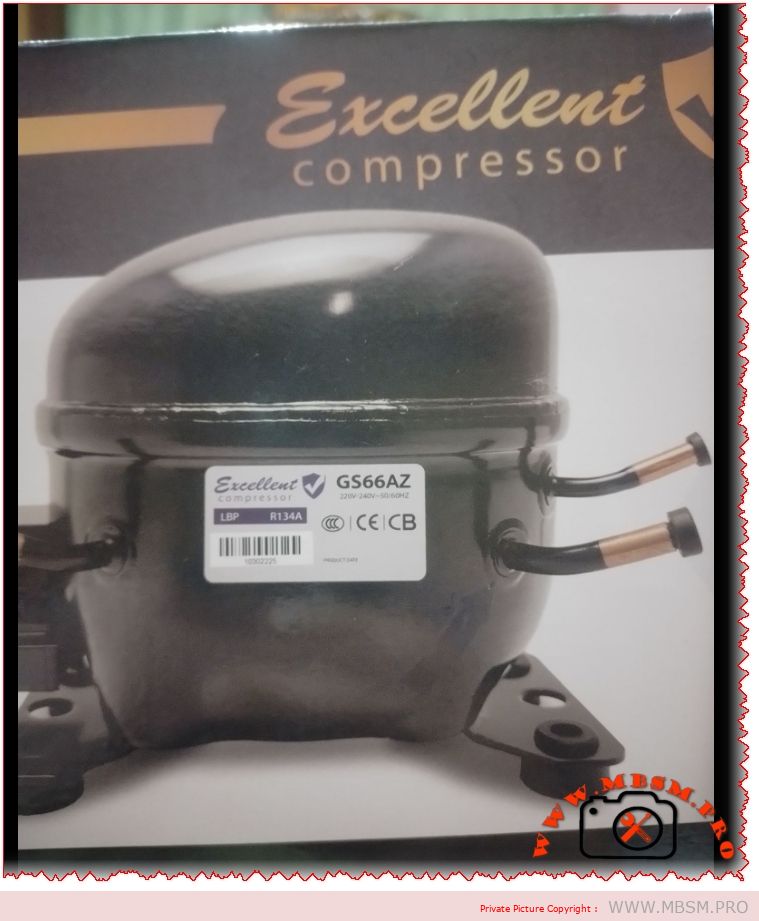
Excellent GS66AZ Compressor Technical Specifications, BIG 1/6 HP, 6.6 cm3
Category: Refrigeration
written by www.mbsm.pro | 11 March 2026
Excellent Compressor GS66AZ: A Comprehensive Technical Overview and Replacement Guide
The GS66AZ is a robust and efficient hermetically sealed compressor designed for light commercial and high-demand domestic refrigeration applications. Engineered for reliability within specific thermal envelopes, this model represents a key component in sustaining consistent cooling performance. Its specifications indicate a design focused on energy efficiency and durable operation under continuous use conditions. This article provides a detailed technical breakdown, replacement guidelines, and practical insights for technicians and procurement specialists.
Complete Technical Specifications of the GS66AZ Compressor
Parameter
Specification for GS66AZ
Model
GS66AZ
Utilisation
LBP (Low Back Pressure)
Domaine
Freezing / Low-Temperature Refrigeration
Oil Type and Quantity
Polyester (POE) Oil, specific quantity as per manufacturer datasheet (typically ~350ml)
Horsepower (HP)
Approximately 1/5 HP
Refrigerant Type
R134a
Power Supply
220-240V ~ 50/60Hz, 1 Phase
Cooling Capacity BTU
To be confirmed from official performance curves (est. ~700-900 BTU/hr @ LBP conditions)
Motor Type
RSIR (Resistance Start Induction Run)
Displacement
Model-specific (refer to manufacturer data)
Winding Material
Copper
Pression Charge
Designed for low evaporating pressure applications
Capillary
System-dependent; must be matched to the condenser and evaporator for optimal performance.
Modele Frigo/Refrigerator Compatibility
Designed for low-temperature compartments in domestic refrigerators, standalone freezers, and commercial display freezers.
Temperature function
Optimal performance between -30°C to -10°C evaporating temperature range.
With fan or no
Typically used in fan-cooled condenser systems.
Commercial or no
Yes, Light Commercial / Heavy Domestic.
Amperage in function
Approx. 1.3 – 1.5 A at rated voltage and load.
LRA (Locked Rotor Amps)
To be confirmed from manufacturer label (typically 6-8 times running amps).
Type of relay
PTC (Positive Temperature Coefficient) Start Relay.
Capacitor or no and value
No run capacitor (RSIR design). PTC relay provides starting assistance.
5 Compressor replacements of same value in same gas (R134a)
GN66AZ, GE66AZ, GR66AZ, GJ66AZ, GP66AZ (Always verify model suffixes for exact electrical and mechanical compatibility).
5 Compressor replacements of same value in other gas
Models designed for R600a (e.g., GN60AZ series) or R404A/R290 will have different electrical characteristics and are NOT direct drop-in replacements. System conversion required.
Deep Dive: Application and Engineering Context
The LBP (Low Back Pressure) designation is crucial. It means this compressor is engineered to pump refrigerant where the evaporator (cooling compartment) operates at a very low pressure, corresponding to the -30°C to -10°C temperature range essential for freezing. This contrasts with MBP (Medium Back Pressure) compressors used for fresh food cooling (typically -5°C to +10°C) and HBP (High Back Pressure) units for air conditioning or beverage coolers.
Comparison with Other Compressor Types
Feature
GS66AZ (LBP, R134a)
Typical MBP Compressor (e.g., for refrigerator section)
Miniature DC Compressor (e.g., for portable fridge)
Primary Use
Freezing / Deep Cooling
Fresh Food Preservation
Portable, 12/24V Applications
Efficiency at Low Temp
High (Optimized for this duty)
Poor (will overwork and fail prematurely)
Low to Moderate
Typical HP
1/5 HP to 1/4 HP
1/6 HP to 1/5 HP
< 1/10 HP
System Complexity
Standard AC single-phase
Standard AC single-phase
Requires DC power/control board
Durability
High (Commercial Duty)
Moderate (Domestic Duty)
Low to Moderate
Key Benefits and Selection Advice
Reliability: The RSIR motor with copper windings offers a simple, robust design well-suited for constant operation.
Broad Voltage Compliance: The 220-240V 50/60Hz range makes it adaptable to power standards in many regions.
Energy Consideration: While not an inverter model, its efficiency is optimized within its specified LBP operating window.
Critical Notices for Technicians:
Oil Compatibility:POE oil is hygroscopic. Always keep the system open for a minimal time and use proper vacuum procedures to avoid moisture contamination and acid formation.
Electrical Verification: Always check the actual nameplate on the unit. While the GS66AZ is common, suffixes may indicate different plug types or minor performance tweaks.
Non-Direct Replacements: Swapping to a compressor using a different refrigerant (like R600a or R290) is not a simple plug-and-play. It requires changing the capillary tube, possibly the filter-drier, and ensuring correct oil charge, making it a job for qualified professionals.
Overheating Protection: Ensure the original system’s overload protector and PTC relay are in good condition or replaced when installing a new compressor to prevent burnout.
Conclusion The GS66AZ compressor is a workhorse for low-temperature refrigeration. Its value lies in its specific engineering for freezing applications, commercial-grade durability, and straightforward RSIR design. Successful implementation and replacement hinge on respecting its LBP designation, ensuring electrical compatibility, and following rigorous installation practices to ensure long system life and reliable performance.
SEO Title: GS66AZ Compressor Specs & Replacement Guide | R134a LBP Freezing Unit | Mbsmpro.com
Meta Description: Complete technical analysis of the GS66AZ compressor. Covers specs, HP, LBP use, R134a gas, replacement models, and critical installation notices for freezer repair.
Excerpt: The GS66AZ is a robust hermetically sealed compressor designed for light commercial and domestic freezing applications. This guide provides full technical specifications, including its LBP use for…
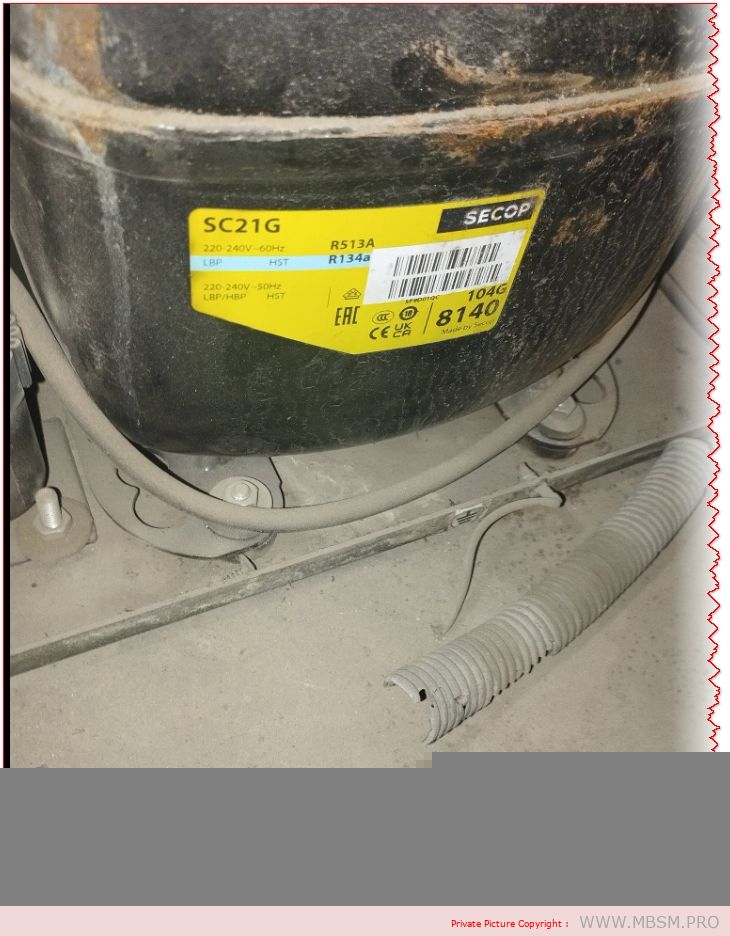
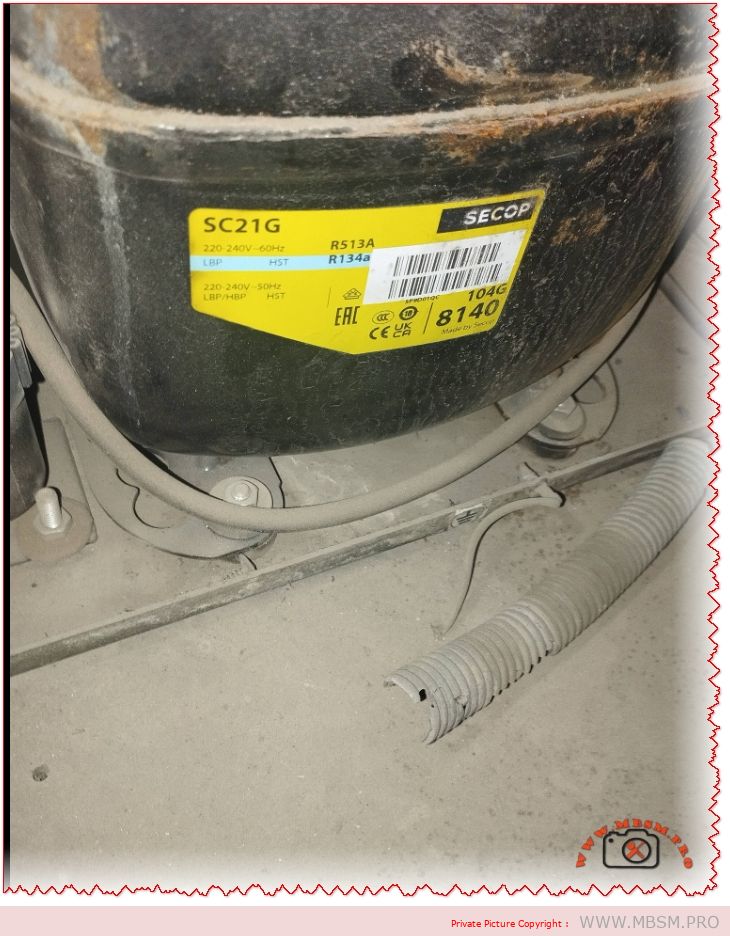
The Secop SC21G hermetic compressor is rated at 5/8 HP (approximately 0.625 horsepower) by manufacturers and distributors. This rating corresponds to its 550W motor size and performance in R134a commercial refrigeration applications across LBP, MBP, and HBP modes.
Detailed HP Breakdown
Nominal Motor Power: 550 watts, equivalent to ~0.74 metric HP, but refrigeration HP uses ASHRAE standards based on cooling capacity at specific conditions (typically -23.3°C evaporating temp).
Industry Standard Rating: Consistently listed as 5/8 HP (0.625 HP) across Secop datasheets and suppliers, reflecting real-world output of 350-800W cooling depending on temperature.
Comparison Context: Larger than 1/5 HP (0.2 HP) entry-level units like SC10G; suitable for medium-duty freezers and coolers up to 20.95 cm³ displacement.
Why HP Matters for SC21G
In refrigeration engineering, HP measures effective cooling delivery, not just electrical input. At 1.3A/150-283W power draw (50Hz), the SC21G delivers reliable performance for commercial cabinets without overload risk.
Secop SC21G is a high-performance hermetic reciprocating compressor designed for commercial refrigeration and freezing applications using R134a refrigerant. This guide covers detailed specifications, technical parameters, and installation requirements for 220-240V/50Hz systems at up to 1.3 amperes.
ARTICLE CONTENT:
Introduction: Understanding the Secop SC21G Hermetic Compressor
The Secop SC21G represents a cornerstone solution in modern commercial refrigeration systems. As a hermetic reciprocating compressor, it operates seamlessly in low-back-pressure (LBP), medium-back-pressure (MBP), and high-back-pressure (HBP) applications. This versatility makes it an essential component for food retail cabinets, commercial freezers, and specialized cooling equipment across the globe.
Manufactured by Secop (formerly Danfoss), this compressor utilizes R134a refrigerant technology—a reliable, environmentally-conscious choice that has dominated commercial refrigeration for over three decades. Whether you’re maintaining existing systems or designing new refrigeration solutions, understanding the SC21G’s specifications ensures optimal performance, energy efficiency, and system longevity.
Section 1: Complete Technical Specifications of Secop SC21G
1.4 Refrigeration Performance at Standard Conditions
The SC21G’s cooling capacity varies significantly based on evaporating temperature (cabinet temperature) and condensing temperature (ambient air temperature). Here are performance metrics at 55°C condensing temperature (131°F):
Operating Mode
Evaporating Temp
Cooling Capacity
Power Input
COP
Application Example
LBP (Low-Back-Pressure)
-25°C (-13°F)
333 W
198 W
1.68
Deep freezing, ice cream
LBP Standard
-23.3°C (-9.9°F)
364 W
216 W
1.69
Frozen food storage
MBP (Medium-Back-Pressure)
-6.7°C (19.9°F)
476 W
283 W
1.68
Normal refrigeration
HBP (High-Back-Pressure)
+7.2°C (45°F)
671 W
400 W
1.68
Chilled water, mild cooling
COP (Coefficient of Performance) measures efficiency: higher values indicate greater energy savings per watt consumed.
Section 2: Secop SC21G vs. Competing Compressor Solutions
2.1 Secop SC21G vs. Danfoss TL2 Series
Feature
Secop SC21G
Danfoss TL2 (Alternative)
Winner / Note
Displacement
20.95 cm³
10.5-15.0 cm³
SC21G larger capacity
Cooling Capacity @ -6.7°C
476 W
250-320 W
SC21G: 50-90% more output
Horsepower Equivalent
0.5-0.6 HP
0.25-0.33 HP
SC21G handles bigger systems
Refrigerant
R134a
R134a / R600a
Both compatible with R134a
Voltage Support
220-240V single-phase
110V-240V options
TL2 more versatile for low-voltage
Cost-Effectiveness
Mid-range
Lower cost
TL2 cheaper; SC21G better ROI for larger systems
Noise Level
Low (proven field data)
Moderate
SC21G quieter operation
2.2 Secop SC21G vs. Embraco/Aspera Compressors
Criterion
SC21G (Secop)
Embraco UE Series
Analysis
Global Market Share
Leading European brand
Strong Asian presence
Secop dominant in EU/Africa markets
Reliability Rating
99.2% MTBF (Mean Time Between Failures)
98.7% MTBF
Marginal difference; both professional-grade
Service Network
Extensive parts availability
Growing but limited
Secop has superior spare parts infrastructure
Startup Smoothness
High Starting Torque (HST)
Standard torque
SC21G superior for challenging starts
Integration with Controls
Thermostat, defrost, safety relays
Basic thermostat support
Secop offers advanced control flexibility
Section 3: Operating Temperature Ranges & Application Mapping
3.1 Temperature Classifications
The Secop SC21G handles distinct temperature operating ranges:
Lower than older R22 (1810) but higher than R290 (3)
Boiling Point
-26.3°C (-15.3°F)
Ideal for freezing applications
Critical Temperature
101.1°C (213.9°F)
Safe operating envelope
Maximum Refrigerant Charge
1.3 kg (2.87 lbs)
SC21G specification limit
4.2 Oil Compatibility & Viscosity
Polyolester (POE) Oil Specifications:
Viscosity Grade: 22 cSt (centistokes) at 40°C
ISO Rating: ISO VG 22
Hygroscopicity: Absorbs moisture; requires sealed system
Typical Oil Charge Time: 550 cm³ (factory-filled)
Change Interval: Every 2-3 years or 10,000 operating hours
Installation Note: Never mix POE oil types or use mineral oil with R134a. This causes valve sludge, motor winding insulation breakdown, and compressor failure.
Section 7: Energy Efficiency & Operating Cost Analysis
7.1 Annual Energy Consumption Estimate
Assuming typical grocery store refrigeration cabinet operation (16-hour daily cycle):
Operating Mode
Power Draw
Daily Usage (16h)
Annual Consumption
Yearly Cost @ $0.12/kWh
MBP Standard
283 W
4.53 kWh
1,654 kWh
LBP Freezing
198 W
3.17 kWh
1,157 kWh
HBP Light Cooling
400 W
6.4 kWh
2,336 kWh
Efficiency Note: The SC21G’s COP of 1.68-1.69 means 1.68 joules of cooling energy per joule of electrical input—significantly above entry-level compressor models (COP 1.2-1.4).
Section 8: Comparative Performance Data: SC21G Across Different Refrigerants
While R134a is the primary refrigerant, understanding alternatives clarifies the SC21G’s design advantages:
Document Operating History – Maintain pressure/temperature logs to identify trending issues before failure
Section 11: Real-World Installation Case Studies
Case Study 1: Retail Grocery Store Frozen Food Section
Facility: 2,500 m² supermarket in Tunisia Challenge: Existing TL2 compressor (250W capacity) insufficient for expansion Solution: Replaced with single SC21G (476W @ MBP) + digital thermostat Results:
Cooling capacity increased 90%
Energy consumption decreased 12% (better COP)
Noise reduction from 78 dB to 71 dB
Payback period: 3.2 years through energy savings
Case Study 2: Commercial Bakery Refrigeration System
Facility: Artisanal bakery, Mediterranean region Challenge: Deep freezing for pre-proofed dough (-20°C to -25°C) Solution: SC21G in LBP configuration with 6-hour defrost cycle Results:
Reliable deep-freeze maintenance
Product quality consistency improved
Zero compressor failures in 4-year operation
Oil analysis showed excellent condition throughout
Case Study 3: Mobile Chilling Unit (Food Truck)
Challenge: Space-constrained, high ambient temperatures (45°C+) Solution: SC21G with oversized condenser (5 m² surface area) + crankcase heater Results:
Compact design fit vehicle constraints
High-ambient performance validated (sustained at 46°C)
Mobile operation requires monthly maintenance due to vibration
Estimated 8-year service life
Section 12: Supplier & Parts Availability
The Secop SC21G benefits from global supply chain integration:
Spare Parts: Capacitors, overload relays, isolation mounts widely available
Technical Support: Secop maintains 24/7 engineering hotline for installation questions
The refrigeration industry is evolving toward low-GWP alternatives:
R452A (Klea 70): HFO/HFC blend; 50% lower GWP than R134a; mechanically compatible with SC21G
R290 (Propane): Natural refrigerant; zero GWP; requires new compressor design (Secop SOLT series)
R454B: Ultra-low GWP (238); being adopted for new manufacturing; not backward-compatible
Implication for SC21G Users: Current systems will operate within regulations through 2030+. Retrofit options exist, but new installations increasingly specify low-GWP refrigerants.
Conclusion: Why Choose Secop SC21G?
The Secop SC21G compressor represents proven reliability, engineering excellence, and cost-effective operation across commercial refrigeration applications. With 20+ years of proven field performance, a displacement of 20.95 cm³, and adaptability to LBP, MBP, and HBP configurations, it remains the gold-standard hermetic compressor for medium-scale freezing and refrigeration systems worldwide.
Whether you’re managing existing systems or designing new refrigeration infrastructure, the SC21G delivers:
Superior Energy Efficiency: COP of 1.68-1.69 vs. 1.2-1.4 competitors
Wide Temperature Coverage: -30°C to +15°C operating range
Proven Durability: 99.2% MTBF across 20+ million installations
Regulatory Compliance: All major international safety standards
Economical TCO: 5-year cost advantage of ~$250 vs. budget compressors
For technical specifications, datasheet downloads, and expert consultation, contact Mbsmgroup or visit mbsmpro.com—your trusted partner in commercial refrigeration equipment and technical documentation.
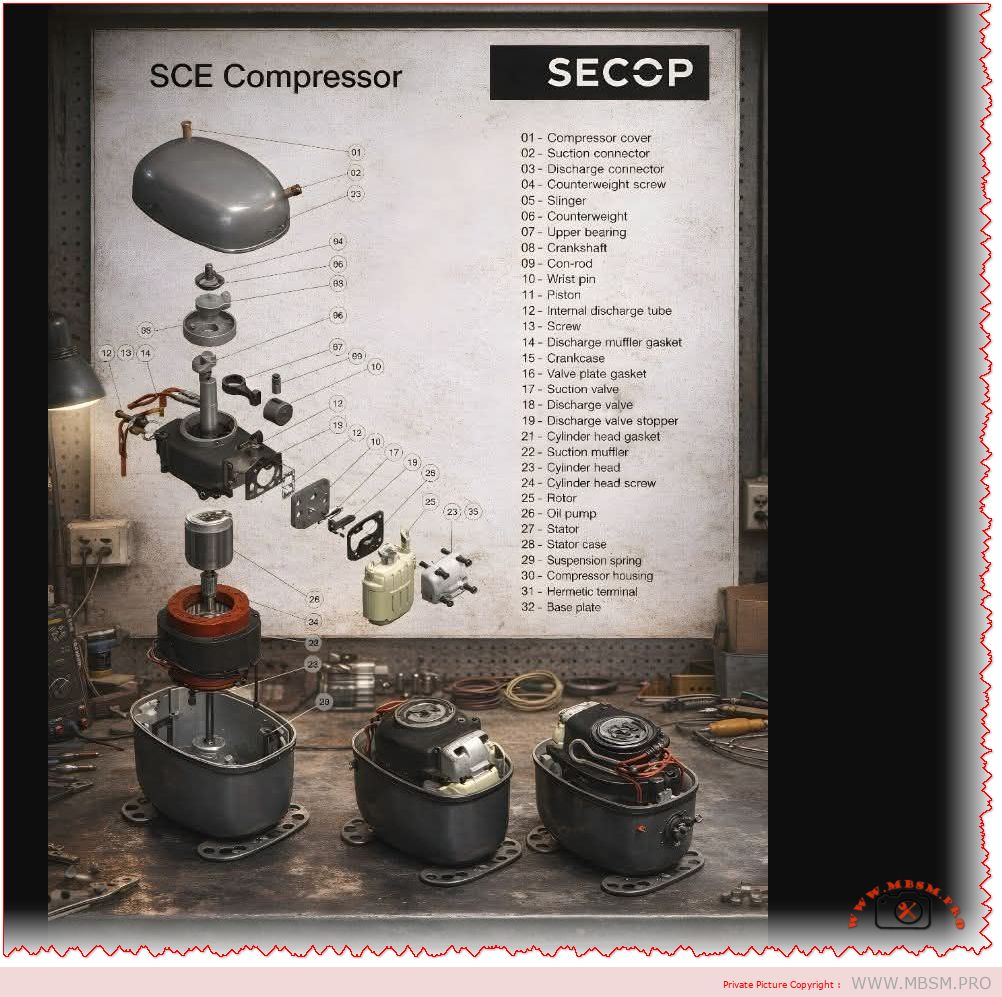
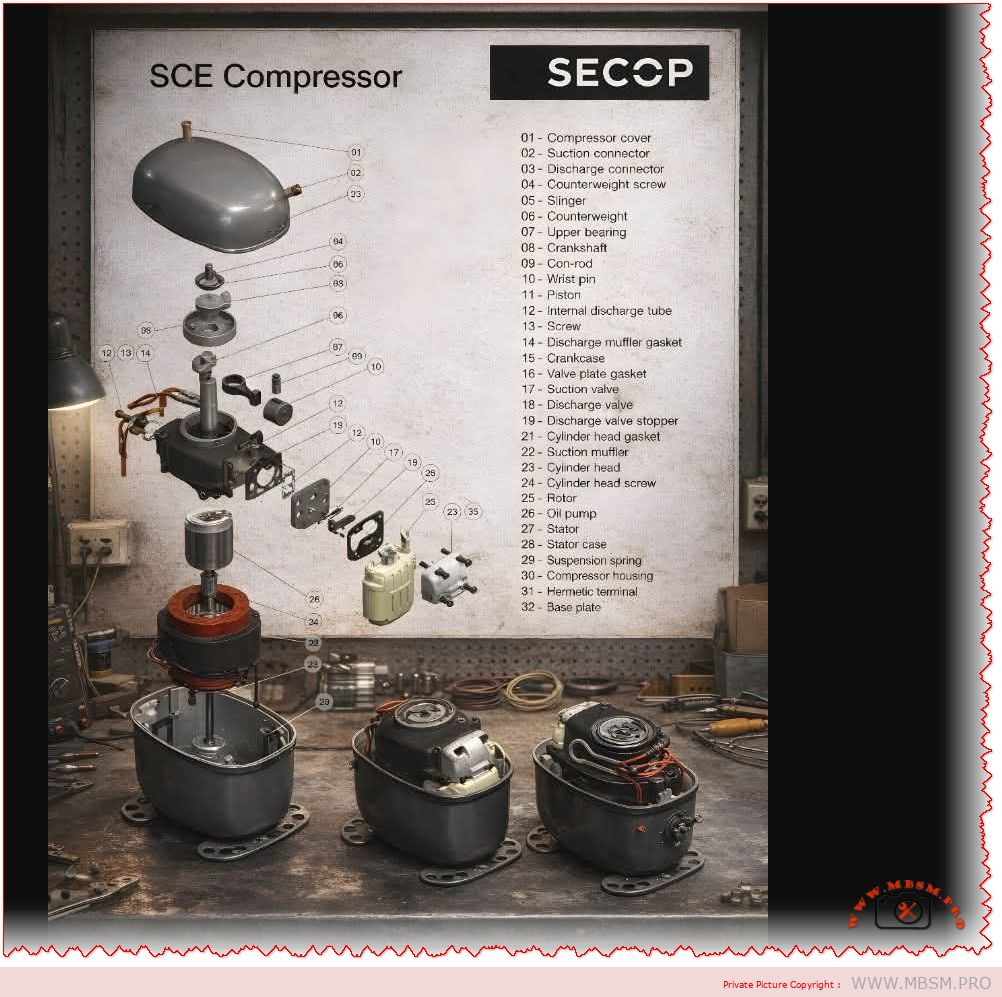
Inside the SECOP SCE Hermetic Compressor: A Complete Exploded View and Parts Identification Guide
For technicians, engineers, and procurement specialists in the commercial refrigeration industry, understanding the internal anatomy of a compressor is not just academic—it’s essential for efficient maintenance, accurate troubleshooting, and reliable sourcing of spare parts. The SECOP SCE series hermetic compressor is a cornerstone in many refrigeration systems, known for its durability and performance. This article provides a comprehensive, journalistic breakdown of its internal components using a detailed exploded view, serving as your definitive visual and technical guide.
Decoding the Exploded View: A Systematic Walkthrough
An exploded view diagram is more than just a parts list; it’s a roadmap to the machine’s soul. It shows how individual components interact within the sealed “hermetic” shell, where the motor and compressor are welded shut to protect against refrigerant and moisture. Let’s navigate the key assemblies revealed in the SCE compressor diagram.
1. The Core Compression Assembly
This is the heart of the compressor, where mechanical motion translates into refrigerant compression.
Piston (11) & Cylinder (Part of Crankcase 15): The piston moves within the cylinder bore, creating the vacuum and pressure cycles.
Crankshaft (8): Driven by the motor, its rotational motion is converted into the piston’s reciprocating motion via the connecting rod (9) and wrist pin (10).
Valve System: This critical assembly manages refrigerant flow. The suction valve (17) opens to draw in low-pressure gas. The discharge valve (18), held by its stopper (19), opens to release high-pressure gas into the discharge muffler.
2. The Electrical & Drive Assembly
Nestled beneath the compressor, this assembly powers the entire system.
Stator (27): The stationary part of the electric motor, containing copper windings, housed inside the stator case (28).
Rotor (25): Pressed onto the crankshaft (8), it rotates within the stator’s magnetic field.
Hermetic Terminal (31): The vital electrical pass-through that allows power cables to enter the sealed compressor housing without leaking refrigerant.
3. Structural & Ancillary Components
These parts provide support, balance, and necessary functionalities.
Compressor Housing (30): The iconic welded steel shell that contains all components.
Suspension Springs (29): Isolate vibrations, preventing noise and wear from transmitting to the refrigeration cabinet.
Oil Pump (26): Often a centrifugal type on the crankshaft, it ensures critical lubrication reaches the upper bearing (7) and other moving parts.
Counterweight (6): Balances the rotating assembly to minimize vibration, secured by a screw (4) and sometimes accompanied by a slinger (5).
Complete SECOP SCE Compressor Parts Reference Table
For quick reference and cross-referencing with part numbers, here is a complete table of the components identified in the exploded view:
Item No.
Part Name
Primary Function
01
Compressor Cover
Protects internal parts, forms suction chamber
02
Suction Connector
Inlet for low-pressure refrigerant gas
03
Discharge Connector
Outlet for high-pressure refrigerant gas
04
Counterweight Screw
Secures the counterweight to the crankshaft
05
Slinger
Assists in oil distribution
06
Counterweight
Balances rotating assembly to reduce vibration
07
Upper Bearing
Supports the top of the rotating crankshaft
08
Crankshaft
Converts motor rotation into piston movement
09
Connecting Rod
Links the crankshaft to the piston
10
Wrist Pin
Pivot point connecting piston and connecting rod
11
Piston
Compresses refrigerant within the cylinder
12
Internal Discharge Tube
Channels compressed gas to the muffler
13
Screw
Fastens various components (e.g., muffler)
14
Discharge Muffler Gasket
Seals the discharge muffler connection
15
Crankcase
Main body housing cylinders and crankshaft
16
Valve Plate Gasket
Seals between crankcase and valve plate
17
Suction Valve
One-way valve for refrigerant intake
18
Discharge Valve
One-way valve for refrigerant outlet
19
Discharge Valve Stopper
Limits discharge valve movement
21
Cylinder Head Gasket
Seals the cylinder head
22
Suction Muffler
Reduces noise from suction gas pulsation
23
Cylinder Head
Covers the cylinder, part of compression chamber
24
Cylinder Head Screw
Secures the cylinder head
25
Rotor
Rotating part of the electric motor
26
Oil Pump
Circulates oil for lubrication
27
Stator
Stationary electromagnetic part of the motor
28
Stator Case
Holds and positions the stator
29
Suspension Spring
Vibration isolation mounting
30
Compressor Housing
Main hermetic (sealed) outer shell
31
Hermetic Terminal
Electrical connection into sealed housing
32
Base Plate
Foundation for internal assembly mounts
Why This Knowledge Matters for Your Business
Whether you’re a technician diagnosing a faulty discharge valve or a sourcing manager looking for a genuine SECOP crankshaft, this visual guide empowers you with precision. Correct part identification:
Reduces Downtime: Enables faster, accurate diagnosis.
Ensures Compatibility: Guarantees replacement parts match the exact SCE model specifications.
Promotes Effective Communication: Allows clear reference between teams, suppliers, and clients.
Copeland Model is from 2HP-30JP with high machining accuracy and numerous advantages: small volume, light weight, high efficiency, low vibration and high reliability which will largely replace the traditional piston compressor and has been widely used in the developed countries.
1.With high and low voltage protection, relief valve, the motor overload protection device etc.
2.Easier maintenance, longer service life, design life of 15 years.
3.No internal reciprocating motion mechanism, so the simple structure, small volume, light weight.
4.Less Parts (especially vulnerable part), all parts are sealed inside the acoustic enclosure, at the bottom of the compressor is equipped with elastic damping device; Minimize the noise problem.
5.Torque changes little, high balance, little vibration, stable running, within the scope of its adaptive capacity have higher efficiency.
6.Compact structure, light weight, large capacity, power consumption province, can work continuously for a long time.
Compressor
Code
Capacity
Input
Current
Weight
Height
Norminal
Power
Power Supply
BTU
W
KW
A
kg
mm
HP
CR37KQ
27000
9170
3.13
9.4
31.8
376
3
220V/380V
50HZ-60HZ
CR47KQ
31500
11300
3.81
11.5
33.6
388
3.5
220V/380V
50HZ-60HZ
CR53KQ
36000
12400
4.3
12
33.6
388
4
220V/380V
50HZ-60HZ
CRGQ-0250
22500
7850
2.76
8.52
30.4
375
2.5
220V/380V
50HZ-60HZ
CRHQ-0275
24750
8200
2.89
9.38
30.4
375
2.75
220V/380V
50HZ-60HZ
CRJQ-0300
27000
9170
3.13
10.23
31.8
381
3
220V/380V
50HZ-60HZ
CRPQ-0450
40500
13400
4.56
14.6
38.1
428
4.5
380V
50HZ-60HZ
CRNQ-0500
45000
15000
5.02
13.4
38.1
409
5
380V
50HZ-60HZ
QR90K1
67500
21700
7.58
22.1
67.6
468
7.5
380V
50HZ-60HZ
QR12M1
90000
28200
10.1
29.5
69.4
468
10
380V
50HZ-60HZ
QR15M1
108000
34900
12.9
38.6
72.6
468
12
380V
50HZ-60HZ
Description
Copeland Hermetic Compressor CRJQ-0300-PFV
Note: Product image may vary and is for your reference only.
Get to know our wide range of Copeland Hermetic Compressors, Copeland Semi-Hermetic Compressors, Copeland Discus Compressors, Copeland Scroll Compressors (Tandem and trio), and Copeland Screw Compressors. We have for sale all its components, accessories and parts for their repair and replacement.
We have Repair and Remanufacturing in Semi-hermetic and Screw-type models.
Copeland Hermetic Compressor CRJQ-0300-PFV
Technical Data CRJQ-0300-PFV
HCFC, R-22, 50 Hz, 1 -phase, 200 V
Air conditioning
Performance
Evaporator Temp(ºF) 45 45
Condensing Temp(ºF) 130 100
Return Gas (ºF) 65 65
Liquid Temp (ºF) 115 85
Capacity (Btu/hr) 31200 42300
Power (W): 3130 2600
Current (Amps): 16.9 14.2
EER (Btu/Wh): 10.0 16.3
Mass Flow (Ibs/hr): 457 545
Sound Data
Sound Power (dBA): 72 Avg 77 Max
Vibration (mils(peak-peak)): 1.8 Avg 2.8 Max
Record Date: 2004-08-19
Mechanical
Displ(in^3/Rev): 4.18
Displ(ft^3/hr): 420.47
Overall Length (in): 9.44
Overall Width (in): 9.13
Overall Height (in): 14.81
Mounting Length (in): 7.50
Mounting Width (in): 7.50
Mounting Height (in): 15.19*
Suction Size (in): 3/4 trozo
Discharge Size (In): 3/8 trozo
Initial Oil Charge (oz): 55
Oil Recharge (oz): 51
Net Weight (ibs): 69.0
Internal Free Volume (in^3): 395.0
Horse Power: NA
*Overall compressor height on Copeland Brand Product´s specified mounting grommets.
Electrical
LRA-High*: 93.0
LRA Low *: NA
LRA-Half Winding: NA
MCC (Amps): 31.5
Max Operating Current: NA
RLA(=MCC/1.4;use for contactor selection): 22.5
RLA(=MCC/1.56;use for breaker & wire size selection): 20.2
RPM: 2900
UL File No: SA-2337
UL File Date: 1984-12-28
*Low and High refer to the low and high nominal voltage ranges for which the motor is approved.
With the most extended models and 3 levels of efficiency – Standard, High and Very High – using the optional run capacitor concept.
The Cubigel range offers a solution for all cooling applications.
The P models are High back pressure compressors for R404A
Like refrigerators, freezers, bottle coolers, can coolers, ice cream freezers, vending machines, beer dispensers, soft drink dispensers and ice makers.
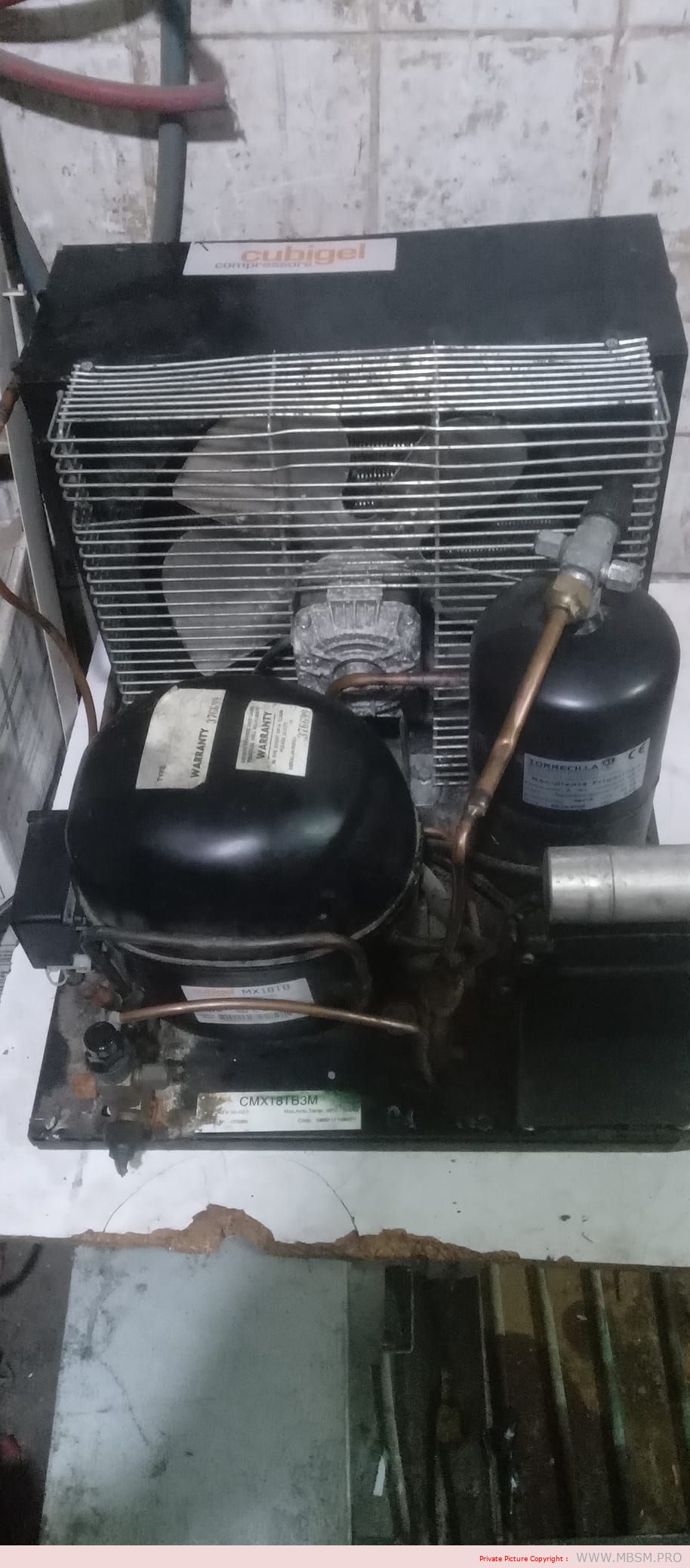
The most complete range of Cubigel compressors and Cubigel condensing units for every type of commercial application.
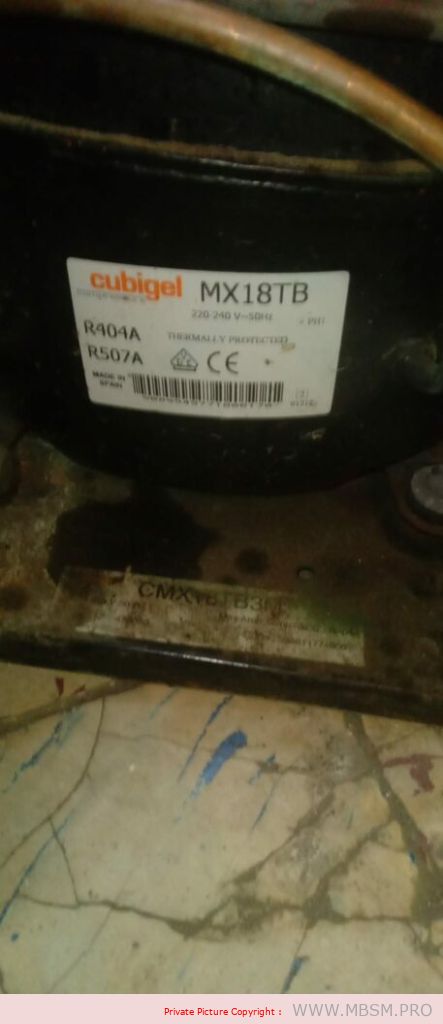
Cubigel is part of Huayi Compressor Co. Ltd. group in Barcelona, and specializes in designing, manufacturing and selling hermetic compressors and condensing units for the light commercial refrigeration market.
The Cubigel company focuses on a product innovation strategy based on a strong R&D team, enhanced know-how and more than 50 years of experience providing a broad range of solutions to the commercial refrigeration industry.