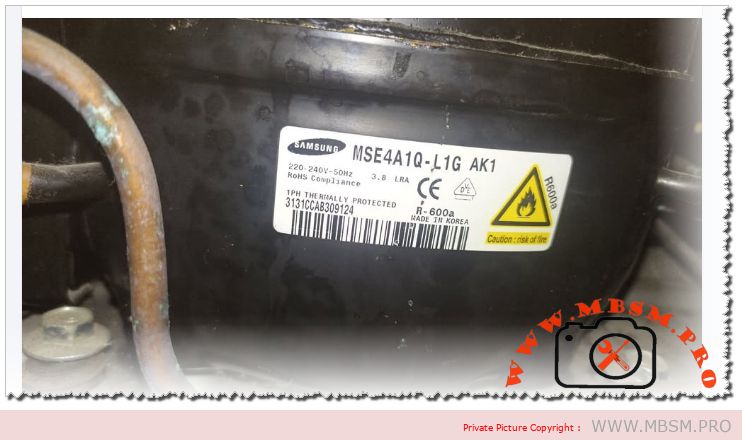
Samsung MSE4A1Q‑L1G AK1, hermetic reciprocating refrigerator compressor
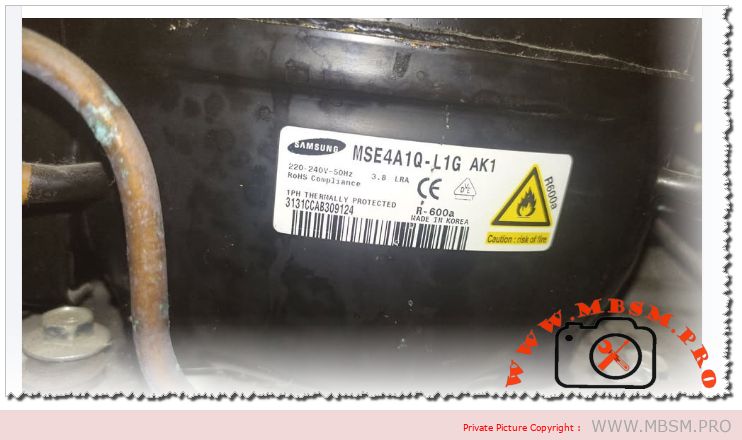
Samsung MSE4A1Q‑L1G AK1, 1/4 hp, R600a, RSCR, LBP, 220‑240V 50Hz Hermetic Compressor Technical Review

The Samsung MSE4A1Q‑L1G AK1 is a hermetic reciprocating refrigerator compressor designed for domestic LBP applications with R600a refrigerant and a nominal cooling capacity around 175–180 W at ASHRAE conditions, equivalent to roughly 1/4 hp.​
Engineers value this model for its efficient RSCR motor, compatibility with eco‑friendly isobutane, and robust design for household refrigerators and freezers.​


Main technical specifications

Samsung lists the MSE4A1Q‑L1G in its AC220‑240V 50 Hz R600a LBP family, sharing the same platform as MSE4A0Q and MSE4A2Q models used in many high‑efficiency fridges.​

Core data of MSE4A1Q‑L1G AK1

Parameter Value
Brand Samsung hermetic compressor ​
Model marking MSE4A1Q‑L1G AK1 (also written MSE4A1QL1G/AK1) ​
Application LBP household refrigerator/freezer, R600a ​
Refrigerant R600a (isobutane), flammable A3 ​
Voltage / frequency 220‑240 V, 50 Hz, single‑phase ​
Motor type RSCR (resistance‑start, capacitor‑run) ​
Cooling capacity (ASHRAE ST) ≈175–203 W, about 695 BTU/h 
Input power ≈118 W at rated conditions 
Efficiency COP around 1.49 W/W at ASHRAE standard 
LRA (locked‑rotor current) 3.8 A shown on nameplate 
Refrigerant charge type Factory designed for R600a only ​
Country of manufacture Korea (typical for this series) 

The combination of ≈175–180 W cooling and ≈118 W electrical input places this compressor in the 1/4 hp class widely used in medium‑size top‑mount and bottom‑mount refrigerators.​


Engineering view: performance and design

From an engineering perspective, the MSE4A1Q‑L1G AK1 is optimised for high efficiency at standard refrigerator evaporator temperatures while maintaining good starting torque with RSCR technology.​

  • The RSCR motor uses a start resistor and run capacitor to improve power factor and efficiency compared with simple RSIR designs, which helps manufacturers meet modern energy‑label targets.​
  • R600a’s low molecular weight and high latent heat allow lower displacement for the same cooling capacity, so the compressor can remain compact while delivering around 695 BTU/h of cooling at −23 °C evaporating conditions.​

For technicians, the relatively low LRA of 3.8 A makes this model easier on start relays and PTC starters, especially in regions with weaker grid infrastructure at 220–240 V.


Comparison with other Samsung R600a LBP compressors

Samsung’s catalog groups the MSE4A1Q‑L1G within a family of R600a reciprocating compressors from about 94 W up to 223 W cooling capacity.​

Position of MSE4A1Q‑L1G in the R600a range

Model Approx. cooling W (ASHRAE ST) Input W COP W/W Approx. hp Typical use Source
MSE4A0Q‑L1G 162–188 W ≈107 W ≈1.51 ≈1/5–1/4 hp Small to medium fridge
MSE4A1Q‑L1G 175–203 W ≈118 W ≈1.49 ≈1/4 hp Medium refrigerator, high‑efficiency
MSE4A2Q‑L1H 192–223 W ≈127 W ≈1.51 ≈1/4+ hp Larger fridge or combi

Compared with MSE4A0Q‑L1G, the MSE4A1Q‑L1G offers a modest step‑up in cooling capacity at similar efficiency, making it a good choice when cabinet size or ambient temperature requires extra margin.​
Against MSE4A2Q‑L1H, it trades some maximum capacity for slightly lower input power, which can be attractive for manufacturers targeting stringent energy‑label thresholds while keeping the same mechanical footprint.​


Professional installation and service advice

Working with R600a compressors like the MSE4A1Q‑L1G requires strict adherence to flammable‑refrigerant standards and best practices.​

Key engineering and safety recommendations

  • Use only tools and recovery systems rated for A3 refrigerants; never retrofit this compressor with R134a or other non‑approved gases because lubrication and motor cooling are optimised for R600a.​
  • Ensure the system charge is accurately weighed with a precision scale, as overcharging even small amounts can increase condensing pressure and reduce COP significantly on low‑displacement units.​
  • Maintain good airflow over the condenser and avoid installing units flush against walls; high condensing temperature quickly erodes the 1.49 W/W efficiency and can trigger thermal protector trips.​

Diagnostic and replacement tips

  • When replacing, match not only voltage and refrigerant but also cooling capacity and LBP application class; choosing a smaller 140 W class unit in place of the MSE4A1Q‑L1G risks long running times and poor pull‑down.​
  • Measure running current after start‑up; a healthy system will draw close to catalog input current at rated conditions, while notably higher current can indicate overcharge, blocked airflow, or partial winding short.

Focus keyphrase (Yoast SEO)

Samsung MSE4A1Q‑L1G AK1 1/4 hp R600a RSCR LBP refrigerator compressor 220‑240V 50Hz technical data and comparison


SEO title

Samsung MSE4A1Q‑L1G AK1, 1/4 hp, R600a, RSCR, LBP, 220‑240V 50Hz Compressor Technical Data | Mbsm.pro


Meta description

Discover the full technical profile of the Samsung MSE4A1Q‑L1G AK1 1/4 hp R600a LBP compressor: cooling capacity, RSCR motor efficiency, engineering advice, and comparisons with other Samsung R600a models.​


Slug

samsung-mse4a1q-l1g-ak1-1-4hp-r600a-lbp-compressor-data


Tags

Samsung MSE4A1Q‑L1G, MSE4A1Q‑L1G AK1, Samsung R600a compressor, 1/4 hp refrigerator compressor, RSCR LBP compressor, 220‑240V 50Hz compressor, Mbsmgroup, Mbsm.pro, mbsmpro.com, mbsm


Excerpt (first 55 words)

The Samsung MSE4A1Q‑L1G AK1 is a hermetic reciprocating refrigerator compressor designed for domestic LBP applications with R600a refrigerant and a nominal cooling capacity around 175–180 W at ASHRAE conditions, equivalent to roughly 1/4 hp. Engineers value this model for its efficient RSCR motor and robust design.​


  • Samsung global compressor page for AC220‑240V 50Hz R600a LBP family (includes MSE4A1Q‑L1G, PDF download link in page).
  • Direct Samsung “SAMSUNG COMPRESSOR” R600a catalog PDF listing MSE4A1Q‑L1G specifications.
  • Samsung AC200‑220V 50Hz R600a LBP compressor family catalog page with PDF.
  • Samsung corporate brochure “Samsung Compressor” PDF covering technical data and performance tables.
  • Spanish “Catalogo Compresores Samsung” PDF on Scribd with R600a LBP tables.
  • Tili Global technical sheet collection for Samsung household reciprocating compressors (model tables in downloadable PDF).
  • Samsung global business main compressor product brochure PDF linked from compressor overview section.
  • Additional Samsung R600a LBP catalog PDF linked in “Download PDF” button for AC220‑240V 50Hz series on product page.
  • Supplementary Samsung compressor specification PDF referenced within Scribd Samsung Compressor document.
  • General Samsung reciprocating compressor catalog PDF referenced across global business compressor section, covering multiple R600a LBP models.​
Samsung MSE4A1Q‑L1G AK1, hermetic reciprocating refrigerator compressor mbsmpro


LM317 Voltage Regulator

LM317 Voltage Regulator: Complete Guide, Pinout, Application Circuit, and Engineering Best Practices

Professional, practical, and ready for WordPress publication — engineered for technicians, makers, and design engineers.

Overview

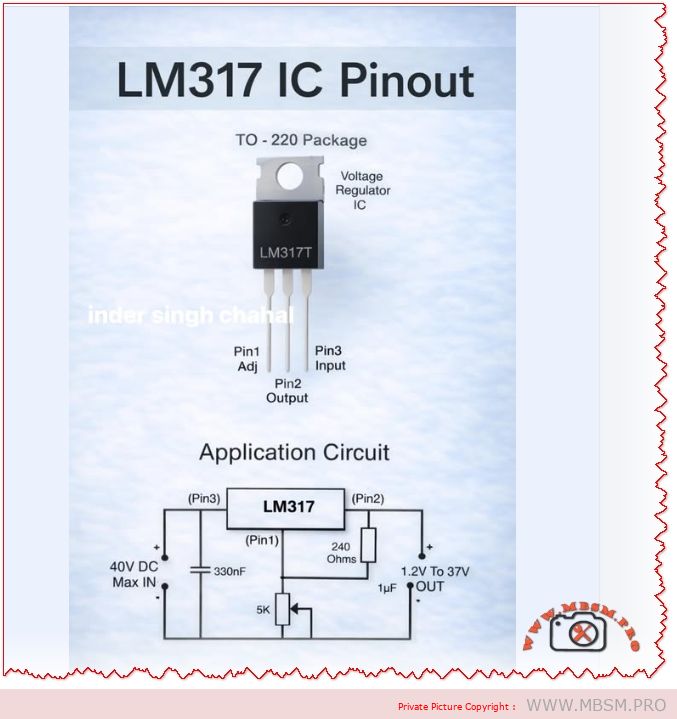
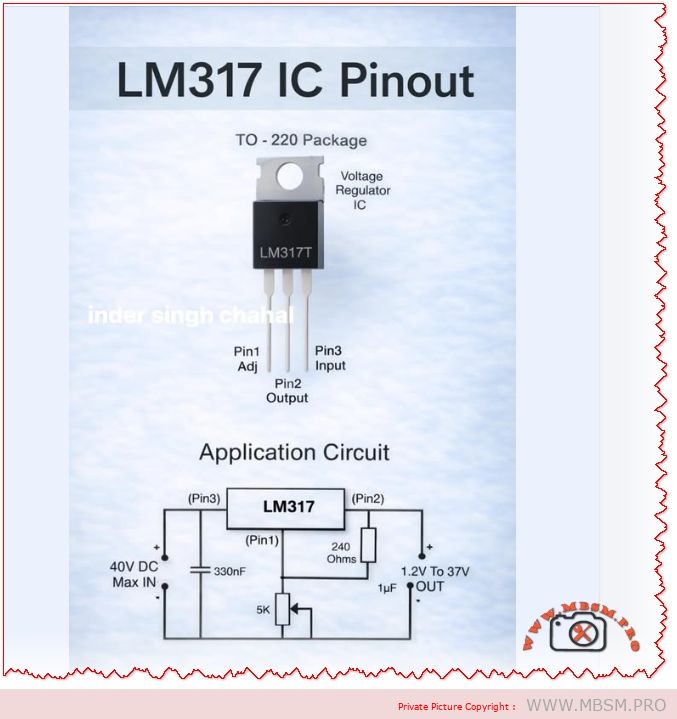
The LM317 is a versatile adjustable linear voltage regulator in a TO‑220 (and SMD) package that delivers a stable output from 1.2 V to 37 V with a maximum input rating of 40 V DC. It’s widely used for bench power supplies, embedded systems, and analog rails where simplicity, low noise, and predictable behavior matter. This article explains pinout and application circuits, common design mistakes, thermal calculations, layout rules, comparisons with alternatives, and practical installation advice.

Pinout and Basic Application

Pin Label Function
1 Adj Adjust input for output set resistor network
2 Out Regulated output voltage
3 In Unregulated input voltage (max 40 V DC)

Typical application components: 240 Ω resistor between Out and Adj, adjustable resistor (e.g., 5 kΩ) between Adj and ground, 330 nF on Adj for stability in some layouts, and 1 µF on Output for transient suppression.

Standard Application Formula

  • Output voltage:

VOUT=VREF(1+R2R1)+IADJR2

where VREF1.25 V, R1 = 240 Ω, R2 is the adjustable resistor.

Recommended Component Values

Component Recommended Value Purpose
R1 240 Ω Sets reference current
R2 variable 0–5 kΩ Sets VOUT range
Cadj 330 nF (optional) Improves transient response and stability
Cout 1 µF low‑ESR Output decoupling and stability
Cin 10 µF (electrolytic) Input decoupling and transient handling

Thermal Design and Power Dissipation

  • Power dissipation:

P=(VINVOUT)ILOAD

.

  • Example: VIN = 24 V, VOUT = 5 V, ILOAD = 0.8 A → P=(245)0.8=15.2 W. 15.2 W requires a substantial heatsink or a switching alternative.

Practical rule: If P>2 W, plan a heatsink or consider a switching regulator. For portable or battery systems, prefer switching converters for efficiency.

Common Mistakes and How to Fix Them

Mistake Effect Fix
No input/output decoupling Oscillation, noise Add 10 µF on input, 1 µF on output, plus 0.1 µF ceramic close to pins
Long traces to caps Instability Place caps within 5 mm of pins; use wide traces
Ignoring thermal dissipation Overheating, thermal shutdown Calculate P; add heatsink or switch to buck converter
Wrong capacitor type Oscillation or poor transient Use low‑ESR electrolytic or tantalum; pair with ceramic
Using LM317 for large VIN–VOUT Excessive wasted heat Use buck converter for large drops or high current
No protection against reverse input Device failure on faults Add diode from Out to In and input transient protection

Layout and PCB Best Practices

  • Place input and output capacitors as close as possible to the regulator pins.
  • Use wide copper pours for VIN and VOUT to reduce thermal resistance.
  • Add thermal vias under SMD packages to move heat to inner layers.
  • Keep adjust resistor network close to Adj pin to minimize noise pickup.
  • Label test points for VIN, VOUT, and ADJ for easy debugging.

Comparison: LM317 vs. AMS1117 vs. Switching Regulators

Attribute LM317 (Adjustable LDO) AMS1117 (Fixed LDO) Buck Converter (Switching)
Output range 1.2–37 V Fixed variants (1.2–5 V) Wide, programmable
Efficiency (large VIN drop) Low Low High
Noise Low Moderate Higher (switching noise)
Thermal stress High for large VIN–VOUT High Low
Complexity Low Very low Higher (inductor, diode, layout)
Best use Bench supplies, analog rails Simple fixed rails High current, battery systems

When to Use LM317

  • You need an adjustable linear rail with low noise.
  • VIN is only slightly higher than desired VOUT (small voltage drop).
  • Current requirements are moderate (typically < 1 A unless heavily heatsinked).
  • Simplicity and low component count are priorities.

When to Avoid LM317

  • High current (> 1 A) with large VIN–VOUT difference.
  • Battery‑powered designs where efficiency is critical.
  • Very low noise analog front ends that require specialized low‑noise LDOs.

Testing and Validation Checklist

  1. No‑load test: Verify VOUT with no load; confirm VREF ≈ 1.25 V across R1.
  2. Load ramp: Apply increasing load and monitor VOUT and temperature.
  3. Thermal soak: Run full expected load for 30 minutes; measure case and PCB temps.
  4. Transient test: Step load and measure recovery time and overshoot.
  5. Ripple test: Check output ripple with oscilloscope; ensure within system tolerance.

Safety Notes and Notices

  • Maximum input voltage: Do not exceed 40 V DC on the input pin.
  • Heat: The package can become hot; use proper insulation and heatsinking.
  • Polarity: Protect against reverse polarity and input transients.
  • Capacitor polarity: Observe electrolytic capacitor polarity to avoid explosion.

Practical Design Examples

Scenario VIN VOUT ILOAD P (W) Recommendation
Small MCU rail 7 V 5 V 0.2 A 0.4 W LM317 with small heatsink
Bench 5 V supply 24 V 5 V 0.8 A 15.2 W Use buck converter or heavy heatsink
Sensor analog rail 12 V 3.3 V 0.1 A 0.87 W LM317 with decoupling caps

FAQ (Short Answers)

  • Can LM317 deliver 1 A? Yes, but only with adequate heatsinking and thermal planning.
  • Do I need the 240 Ω resistor? Yes; it sets the reference current and stabilizes the regulator.
  • How to reduce noise? Use proper decoupling, a 0.1 µF ceramic near pins, and a low‑ESR output cap.

Focus Keyphrase

LM317 adjustable voltage regulator TO‑220 pinout 1.2–37V 40V IN application circuit thermal design decoupling layout mistakes

SEO Title

Mbsmpro.com, LM317 Voltage Regulator, TO‑220, 1.2–37V, 40V IN, Pinout, Application Circuit, Thermal Design

Meta Description

Complete LM317 guide: pinout, application circuit, component values, thermal calculations, PCB layout tips, common mistakes, and comparisons with AMS1117 and switching regulators.

Slug

lm317-voltage-regulator-to-220-1-2-37v-40v-in-pinout-application

Tags

LM317, Voltage Regulator, TO-220, Adjustable LDO, 1.2V, 3.3V, 5V, Thermal Design, Decoupling, PCB Layout, Mbsmgroup, Mbsm.pro, mbsmpro.com, mbsm, Electronics, Power Supply

Excerpt (first 55 words)

LM317 is a flexible adjustable linear regulator delivering 1.2 V to 37 V from a 40 V max input. This guide covers pinout, recommended component values, thermal calculations, layout best practices, common mistakes, and when to choose switching alternatives for efficiency and high current.

LM317 Voltage Regulator mbsmpro


AMS1117 Voltage Regulator

AMS1117 Voltage Regulator: Common Mistakes, Practical Guide, and Engineering Best Practices

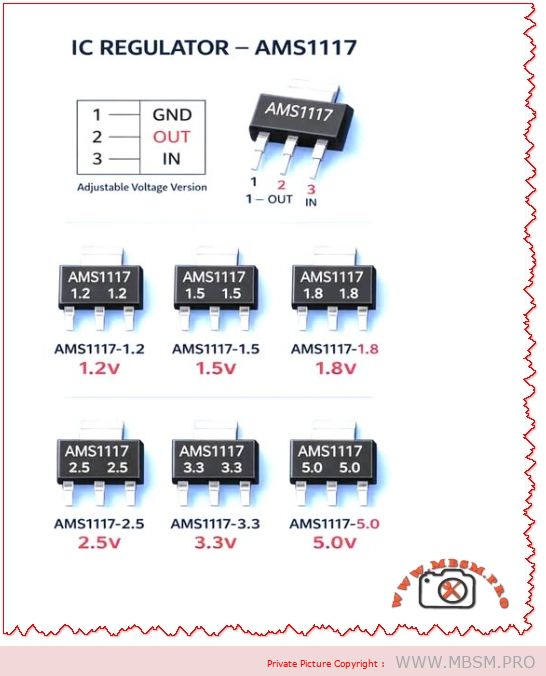
Overview The AMS1117 family of linear voltage regulators (fixed and adjustable versions) is ubiquitous in electronics projects, embedded systems, and power-supply rails. Despite its popularity, technicians and hobbyists repeatedly make the same installation and design mistakes that cause overheating, instability, and premature failure. This article explains those common mistakes, gives engineering‑grade corrections, compares AMS1117 variants with alternatives, and supplies practical tables, values, and installation checklists you can use in a WordPress technical post.

Why AMS1117 Is Widely Used

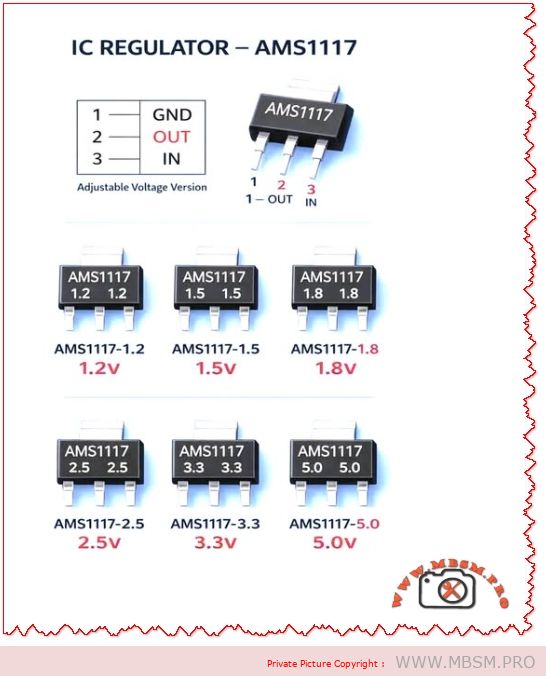
  • Simple three‑pin package (GND, OUT, IN) makes board layout straightforward.
  • Multiple fixed outputs available: 1.2V, 1.5V, 1.8V, 2.5V, 3.3V, 5.0V.
  • Low cost and broad availability for hobby and production use.
  • Good for low‑current rails (typical use up to ~1 A with proper thermal design).

Common Mistakes and Corrective Actions

Common Mistake Why it Fails Corrective Action
No input/output decoupling capacitors Regulator oscillates or output is noisy Place recommended capacitors: input 10 µF (electrolytic or tantalum) and output 10 µF low‑ESR close to pins
Ignoring thermal dissipation Device overheats under load; thermal shutdown Calculate power dissipation P=(VINVOUT)ILOAD; add heatsink or use switching regulator if P>1 W
Long traces between caps and pins Increased ESR/ESL causes instability Route short, wide traces; place caps within 5 mm of pins
Using AMS1117 for high step‑down Excessive wasted power and heat Use buck converter for large VIN–VOUT or high current
No reverse‑polarity or transient protection Device destroyed by spikes or reverse connection Add input TVS diode, series fuse, or reverse‑polarity MOSFET
Wrong capacitor type ESR too high or too low causing instability Use low‑ESR electrolytic or tantalum on output; ceramic + electrolytic combo on input
Expecting full 1 A without thermal design Device current limit or thermal shutdown Derate to 0.7–0.8 A unless heatsink and airflow provided

Practical Design Checklist (Quick Reference)

  • Select correct AMS1117 variant for required output voltage (1.2 / 1.5 / 1.8 / 2.5 / 3.3 / 5.0 V).
  • Calculate worst‑case dissipation: Pmax=(VIN,maxVOUT)Imax.
  • Choose caps: Input 10 µF low‑ESR; Output 10 µF low‑ESR; add 0.1 µF ceramic for high‑frequency decoupling.
  • Thermal plan: Heatsink area, copper pour, and airflow if Pmax>1 W.
  • Layout: Short traces, wide copper, thermal vias under package for SMD variants.
  • Protection: Input TVS, series fuse, reverse‑polarity protection.
  • Testing: Thermal imaging under full load; measure output ripple and transient response.

Thermal Calculation Example

  • Given: VIN = 12 V, VOUT = 5 V, ILOAD = 0.8 A
  • Dissipation: P=(125)0.8=5.6 W
  • Implication: 5.6 W requires substantial heatsinking; AMS1117 in a TO‑220 or SOT‑223 without heatsink will overheat. Consider switching regulator.

Comparison Table: AMS1117 vs. Common Alternatives

Attribute AMS1117 (Linear) LM2596 (Buck) LDO Modern (e.g., MIC5219)
Efficiency at 5 V out from 12 V in ~42% ~85–95% ~42–60%
Typical max current ~1 A (thermally limited) 3 A (switching) 500 mA–1 A
Output noise Low‑mid Higher switching noise Low
Board complexity Low Higher (inductor, diode, caps) Low
Thermal stress High for large VIN–VOUT Low Moderate
Best use case Small loads, simple designs High current, large step‑down Low‑noise low‑current rails

When to Choose AMS1117 (Use Cases)

  • Low‑power microcontroller rails (e.g., 3.3 V at < 300 mA).
  • Simple sensor boards where VIN is close to VOUT (small voltage drop).
  • Prototyping and low‑volume products where cost and simplicity matter.

When to Avoid AMS1117 (Alternatives)

  • High current (>1 A) or large VIN–VOUT difference — use a buck converter.
  • Battery‑powered designs where efficiency is critical — use switching regulator.
  • Very low noise analog rails — choose a precision LDO with low noise spec.

Layout and PCB Best Practices

  • Place caps within 2–5 mm of regulator pins.
  • Use wide input and output traces (or pour copper) to reduce voltage drop and improve heat spreading.
  • Add thermal vias under SMD packages to move heat to inner or bottom copper.
  • Keep sensitive analog traces away from the regulator’s hot copper and switching nodes (if present).
  • Label polarity clearly and include test points for VIN, VOUT, and GND.

Testing and Validation Steps

  1. No‑load test: Verify VOUT with no load; check for oscillation.
  2. Step‑load test: Apply sudden load changes and measure transient response.
  3. Thermal test: Run at maximum expected load for 30 minutes; measure case and PCB temps.
  4. Ripple test: Measure output ripple with oscilloscope; ensure within tolerance for your circuit.
  5. Fault test: Simulate short‑circuit and overvoltage to confirm protection behavior.

Common Failure Modes and Troubleshooting

  • Symptom: Output drops under load → Check thermal shutdown, insufficient input voltage, or current limit.
  • Symptom: Output noisy or oscillating → Check output capacitor ESR and placement.
  • Symptom: Device hot to touch → Check power dissipation calculation and add heatsink or switch to buck converter.
  • Symptom: No output → Check input presence, reverse polarity protection, and solder joints.

Engineering Notes and Practical Tips

  • Combine capacitors: a 0.1 µF ceramic in parallel with a 10 µF electrolytic gives best high‑ and low‑frequency performance.
  • Derate current: assume 70–80% of the absolute max in real designs unless thermal path is proven.
  • Use thermal simulation or simple hand calculations to size copper pour and heatsink.
  • Document expected VIN range and include transient protection if VIN can spike (e.g., automotive or industrial environments).

Focus Keyphrase

AMS1117 common mistakes thermal design decoupling capacitor layout oscillation protection buck alternative 1.2V 1.8V 3.3V 5V regulator

SEO Title

Mbsmpro.com, AMS1117 Voltage Regulator, Common Mistakes, Thermal Design, 1.2V–5.0V, Decoupling, Layout, Alternatives

Meta Description

Avoid overheating and instability with AMS1117 regulators. Learn the most common mistakes, thermal calculations, capacitor recommendations, PCB layout tips, and when to choose a buck converter instead.

Slug

ams1117-common-mistakes-thermal-design-decap-layout-alternatives

Tags

AMS1117, Voltage Regulator, LDO, Decoupling, Thermal Design, PCB Layout, Buck Converter, 3.3V, 5V, Mbsmgroup, Mbsm.pro, mbsmpro.com, mbsm, Electronics, Power Supply

Excerpt (first 55 words)

AMS1117 linear regulators are simple and cheap, but common mistakes—missing decoupling, poor thermal planning, and long traces—cause instability and overheating. This guide explains capacitor choices, power dissipation math, PCB layout rules, testing steps, and when to switch to a buck converter for efficiency and reliability.

AMS1117 Voltage Regulator mbsmpro


Embraco FMXY9C Compressor: R600a, 1/6 HP

Embraco FMXY9C Compressor: R600a, 1/6 HP, Fullmotion Inverter, 220-240V, LBP Cooling – Technical Review and Comparison

This article provides a full technical breakdown of the Embraco FMXY9C compressor, including specs, performance, comparisons, and engineering advice for refrigeration systems.

Mbsmpro.com, Compressor, FMXY9C, Embraco, R600a, 1/6 hp, Cooling, 220-240V, 1Ph 50Hz, LBP, Fullmotion, Inverter, −35°C to −10°C, CE UL, Austria

Overview of Embraco FMXY9C Compressor

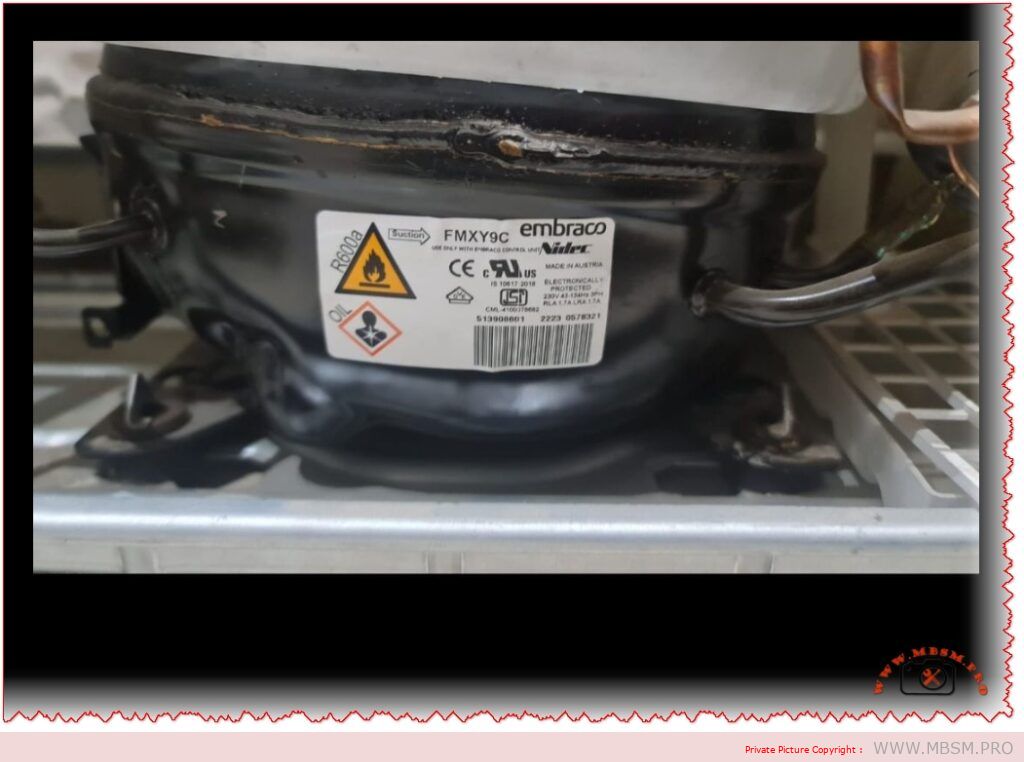
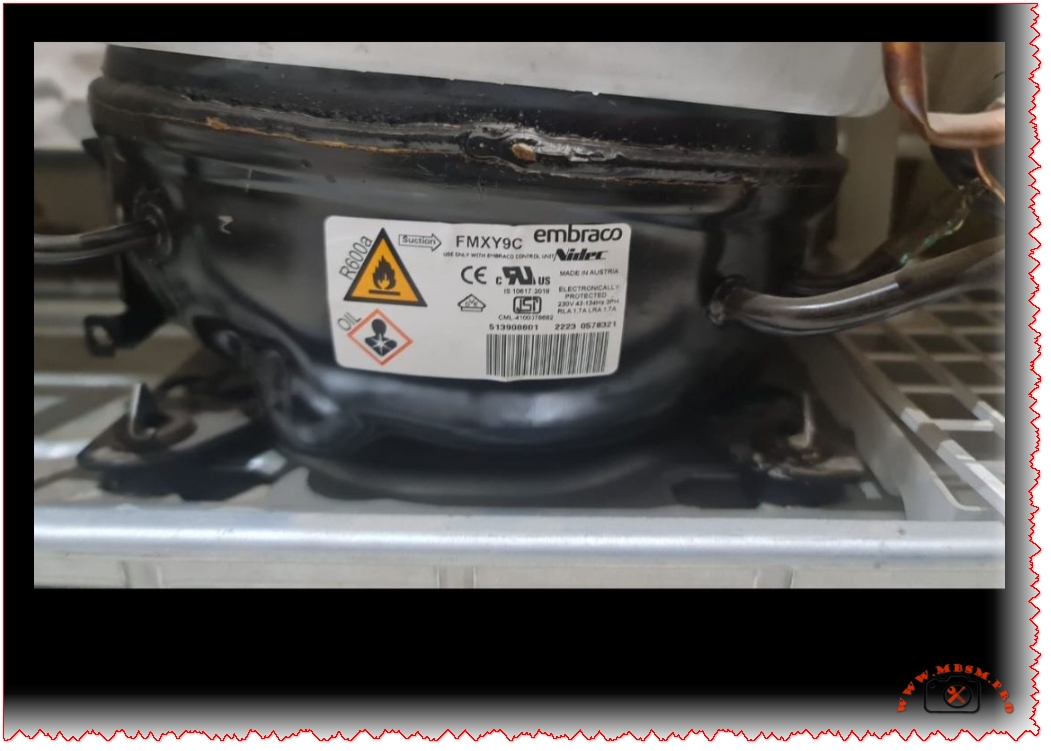
The Embraco FMXY9C is a hermetic reciprocating compressor designed for low back pressure (LBP) refrigeration systems. It uses R600a (isobutane) refrigerant, offering high efficiency and low environmental impact. Built in Austria, this model features Fullmotion inverter technology, allowing variable speed operation for optimized cooling and energy savings.

Technical Specifications Table

Parameter Value
Model FMXY9C
Brand Embraco
Refrigerant R600a
Voltage/Frequency 220-240V / 50Hz
Phase Single (1Ph)
Rated Load Amps (RLA) 1.1 A
Locked Rotor Amps (LRA) 1.7 A
HP Rating ~1/6 HP
Cooling Type LBP
Compressor Type Fullmotion (Inverter)
Displacement 8.74 cm³
Max Winding Temp 130°C
Certifications CE, UL
Origin Austria
Oil Type Alkyl Benzene
Application Range −35°C to −10°C

Comparison with Similar Compressors

Model Refrigerant HP Rating Application Voltage Technology
FMXY9C R600a ~1/6 HP LBP 220-240V Fullmotion Inverter
VTH1113Y R600a ~1/6 HP LBP 220-240V Inverter
NEK6210U R290 ~1/5 HP MBP 115V RSIR

FMXY9C offers superior energy control and quieter operation compared to fixed-speed models like NEK6210U.

Engineering Insights & Usage Tips

  • Fullmotion Technology: Adjusts compressor speed based on cooling demand, reducing energy consumption.
  • R600a Refrigerant: Eco-friendly with zero ozone depletion, but flammable—requires sealed systems and proper ventilation.
  • Electronic Protection: Prevents overload and ensures safe operation under voltage fluctuations.
  • Maintenance Advice: Use only Embraco-approved components and compatible oil to maintain performance and warranty.

Benefits of FMXY9C Compressor

  • Energy Efficiency: Variable speed operation reduces power draw.
  • Quiet Performance: Ideal for residential and commercial refrigeration.
  • Durability: Designed for high ambient temperatures and long duty cycles.

Focus Keyphrase

Embraco FMXY9C Compressor R600a 1/6 HP Fullmotion Inverter 220-240V 50Hz LBP Cooling Austria CE UL Specs Comparison

SEO Title

Mbsmpro.com, Compressor, FMXY9C, Embraco, R600a, 1/6 hp, Cooling, 220-240V, 1Ph 50Hz, LBP, Fullmotion

Meta Description

Explore the full specifications of Embraco FMXY9C compressor for refrigeration systems using R600a. Includes technical tables, performance comparisons, and engineering advice for LBP cooling applications.

Slug

embraco-fmxy9c-compressor-r600a-220v-lbp-fullmotion-specs

Tags

Embraco, FMXY9C, R600a, Compressor, Inverter, Fullmotion, LBP, Cooling, 220-240V, Mbsmgroup, Mbsm.pro, mbsmpro.com, mbsm, Austria, CE, UL

Excerpt

The Embraco FMXY9C compressor is a high-efficiency inverter model using R600a refrigerant. Designed for LBP applications, it operates on 220-240V and offers quiet, reliable cooling with electronic protection.

Embraco FMXY9C Compressor: R600a, 1/6 HP mbsmpro


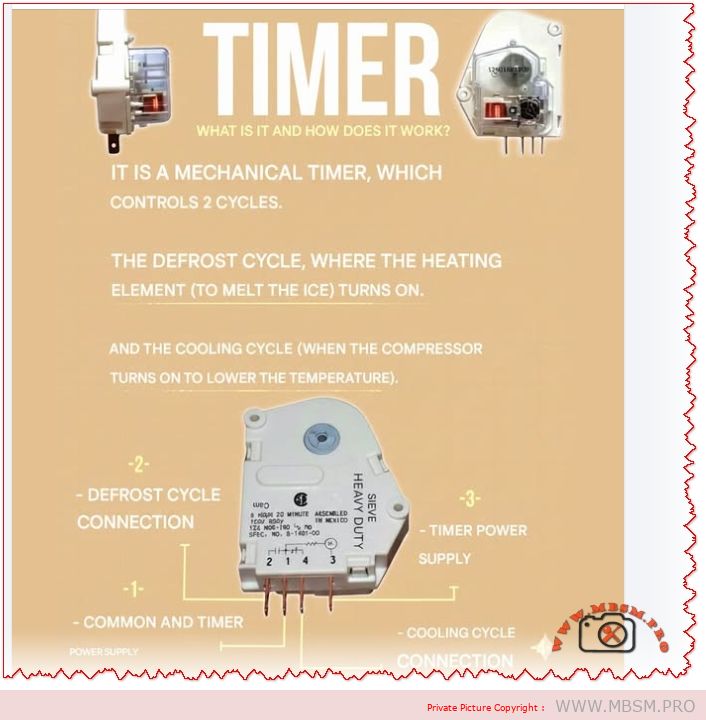
Mechanical Defrost Timer LUFO HPT-02: Wiring

Mechanical Defrost Timer LUFO HPT-02: Wiring, Function, and Engineering Comparison for Refrigeration Systems

Explore how the LUFO HPT-02 mechanical timer manages defrost and cooling cycles in refrigeration systems, with wiring insights and performance comparisons.

Mbsmpro.com, Timer, LUFO HPT-02, 30 Minute, 120 VAC, 60 Hz, 15A, 3/4 HP, Defrost Cycle, Cooling Cycle, Mechanical Control, Heavy Duty, Wiring Diagram

What Is a Mechanical Defrost Timer?

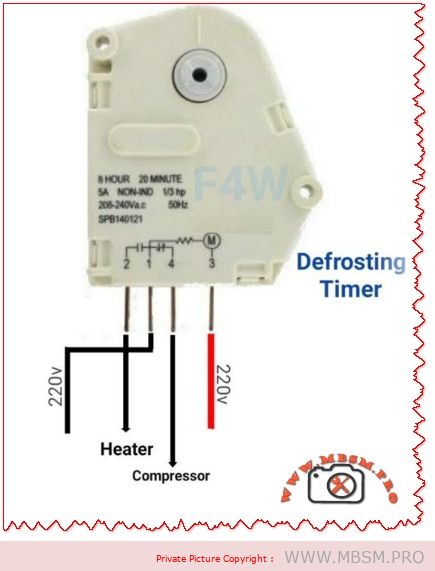
A mechanical defrost timer is a critical component in refrigeration systems, especially in freezers and commercial coolers. It alternates between two cycles:

  • Defrost Cycle: Activates a heating element to melt accumulated ice.
  • Cooling Cycle: Powers the compressor to maintain low temperatures.

The LUFO HPT-02 is a 30-minute timer rated for 120 VAC at 60 Hz, handling up to 15A resistive load and 3/4 HP motor load. It’s built for heavy-duty applications and uses a 4-terminal wiring configuration.

Wiring Table for LUFO HPT-02 Timer

Terminal Function
1 Common and Timer Power Supply
2 Defrost Cycle Connection
3 Timer Power Supply
4 Cooling Cycle Connection

Comparison: LUFO HPT-02 vs. Digital Defrost Timers

Feature LUFO HPT-02 Digital Timer
Type Mechanical Electronic
Voltage 120 VAC 120–240 VAC
Cycle Control Fixed (30 min) Programmable
Reliability High Moderate
Cost Lower Higher
Maintenance Minimal Requires updates

Mechanical timers like LUFO HPT-02 are preferred in rugged environments due to their simplicity and durability.

Engineering Insights & Installation Tips

  • Ensure correct terminal wiring to avoid short circuits or cycle misfires.
  • Use surge protection to extend timer lifespan.
  • Verify compatibility with compressor and heater ratings before installation.
  • Test cycle intervals after setup to confirm proper switching.

Benefits of Mechanical Timers in Refrigeration

  • No software failures or digital glitches.
  • Easy replacement and low maintenance.
  • Reliable cycle control for consistent defrosting and cooling.

Focus Keyphrase

LUFO HPT-02 Mechanical Defrost Timer Wiring Diagram 120VAC 60Hz 30 Minute Cycle for Refrigeration Systems Heavy Duty Cooling Defrost Control

SEO Title

Mbsmpro.com, Timer, LUFO HPT-02, 30 Minute, 120 VAC, 60 Hz, 15A, 3/4 HP, Defrost and Cooling Cycle Wiring

Meta Description

Discover how the LUFO HPT-02 mechanical timer controls defrost and cooling cycles in refrigeration systems. Includes wiring table, engineering advice, and comparisons with digital timers.

Slug

lufo-hpt-02-mechanical-defrost-timer-wiring-120vac-30min

Tags

LUFO, HPT-02, Timer, Defrost, Cooling, Mechanical, Wiring, 120VAC, 60Hz, Mbsmgroup, Mbsm.pro, mbsmpro.com, mbsm, Refrigeration, Heavy Duty

Excerpt

The LUFO HPT-02 mechanical timer alternates between defrost and cooling cycles in refrigeration systems. Rated at 120 VAC and 15A, it offers reliable control with a simple 4-terminal wiring setup.

Mechanical Defrost Timer LUFO HPT-02: Wiring mbsmpro


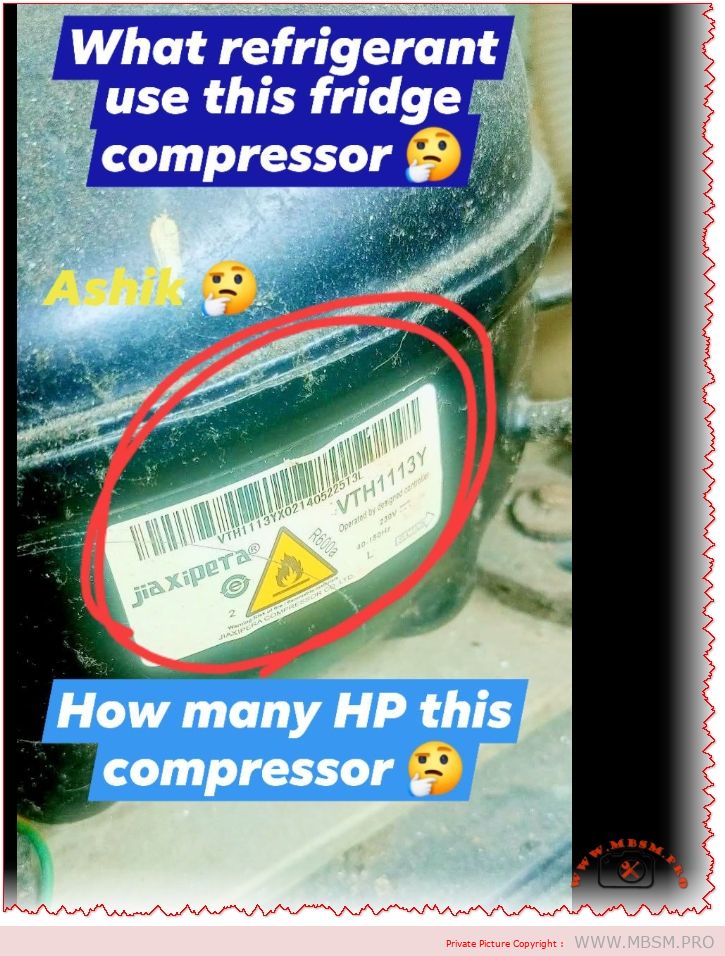
Jiaxipera VTH1113Y Compressor: R600a

Jiaxipera VTH1113Y Compressor: R600a, 220-240V, LBP Cooling, Technical Breakdown and Engineering Insights

Jiaxipera VTH1113Y Compressor Horsepower Rating

The Jiaxipera VTH1113Y compressor is typically rated at approximately 1/6 HP (Horsepower). This rating aligns with its application in low back pressure (LBP) systems, such as household refrigerators using R600a refrigerant. The compressor is designed for efficient cooling in temperature ranges from −35°C to −10°C, making it suitable for static cooling environments.

Comparison Table: HP Ratings of Similar Compressors

Model Refrigerant HP Rating Application
VTH1113Y R600a ~1/6 HP LBP
VTX1116Y R600a ~1/5 HP MHBP
VNC1118Z R134a ~1/5 HP HBP

Engineering Insight

  • 1/6 HP compressors are ideal for compact refrigerators and deep freezers.
  • They offer low energy consumption and quiet operation, especially when paired with inverter technology.
  • R600a refrigerant enhances efficiency but requires careful handling due to its flammability.

Copy All for WordPress:

Jiaxipera VTH1113Y Compressor Horsepower Rating

The Jiaxipera VTH1113Y compressor is typically rated at approximately 1/6 HP (Horsepower). This rating aligns with its application in low back pressure (LBP) systems, such as household refrigerators using R600a refrigerant. The compressor is designed for efficient cooling in temperature ranges from −35°C to −10°C, making it suitable for static cooling environments.

Model Refrigerant HP Rating Application
VTH1113Y R600a ~1/6 HP LBP
VTX1116Y R600a ~1/5 HP MHBP
VNC1118Z R134a ~1/5 HP HBP

1/6 HP compressors are ideal for compact refrigerators and deep freezers. They offer low energy consumption and quiet operation, especially when paired with inverter technology. R600a refrigerant enhances efficiency but requires careful handling due to its flammability.

This article explores the Jiaxipera VTH1113Y compressor used in inverter refrigerators, highlighting its specifications, performance, and comparisons with similar models.

Mbsmpro.com, Compressor, VTH1113Y, Jiaxipera, R600a, 220-240V, 1PH, 50Hz, LBP, Static Cooling, −35°C to −10°C, Alkyl Benzene Oil, ASHRAE Standard

Technical Overview of Jiaxipera VTH1113Y Compressor

The Jiaxipera VTH1113Y is a hermetic inverter compressor designed for household refrigerators using R600a (isobutane) refrigerant. It operates on 220-240V at 50Hz, with a single-phase configuration. This model is optimized for Low Back Pressure (LBP) applications, making it ideal for cooling environments ranging from −35°C to −10°C.

Performance Specifications Table

Parameter Value
Refrigerant R600a
Voltage/Frequency 220-240V / 50Hz
Cooling Type Static
Application LBP
Evaporating Temp Range −35°C to −10°C
Displacement 8.9 cm³
Max Winding Temp 130°C
Max Discharge Pressure 0.98 MPa
COP Range 1.60 – 1.72
Power Consumption 40.7W – 131.3W
Current Range 0.44A – 1.25A
Speed Range 1320 – 4500 RPM
Oil Type Alkyl Benzene

Comparison with Similar Compressors

Model Refrigerant HP Rating Application COP Voltage
VTH1113Y R600a ~1/6 HP LBP 1.60–1.72 220-240V
VTX1116Y R600a ~1/5 HP MHBP 1.65–1.75 220-240V
VNC1118Z R134a ~1/5 HP HBP 1.55–1.70 220-240V

VTH1113Y is best suited for low-temperature applications, while VTX1116Y and VNC1118Z serve medium and high pressure systems respectively.

Engineering Insights & Usage Recommendations

  • Use in LBP Systems: Ideal for deep-freezing and low-temperature refrigeration.
  • R600a Compatibility: Environmentally friendly with low GWP, but requires leak-proof systems due to flammability.
  • Voltage Stability: Ensure consistent 220-240V supply to avoid overload protection triggers.
  • Oil Maintenance: Use only Alkyl Benzene oil for optimal lubrication and longevity.

Benefits of VTH1113Y Compressor

  • Energy Efficient: High COP values reduce electricity consumption.
  • Quiet Operation: Inverter technology minimizes noise.
  • Durable Design: Withstands high discharge pressure and ambient temperatures up to 43°C.

Focus Keyphrase

Jiaxipera VTH1113Y Compressor R600a 220-240V 50Hz LBP Cooling Static Inverter Refrigerator Technical Specifications Comparison

SEO Title

Mbsmpro.com, Compressor, VTH1113Y, Jiaxipera, R600a, 220-240V, LBP, Static Cooling, −35°C to −10°C

Meta Description

Explore the full specifications of Jiaxipera VTH1113Y compressor for inverter refrigerators using R600a. Includes technical tables, performance comparisons, and engineering advice for LBP cooling systems.

Slug

jiaxipera-vth1113y-compressor-r600a-220v-lbp-specs

Tags

Jiaxipera, VTH1113Y, R600a, Compressor, Inverter, Refrigerator, LBP, Mbsmgroup, Mbsm.pro, mbsmpro.com, mbsm, Cooling, Static, 220-240V

Excerpt

Jiaxipera VTH1113Y is a high-efficiency inverter compressor using R600a refrigerant. Designed for LBP applications, it operates on 220-240V and offers quiet, reliable cooling for household refrigerators.

Jiaxipera VTH1113Y Compressor: R600a mbsmpro


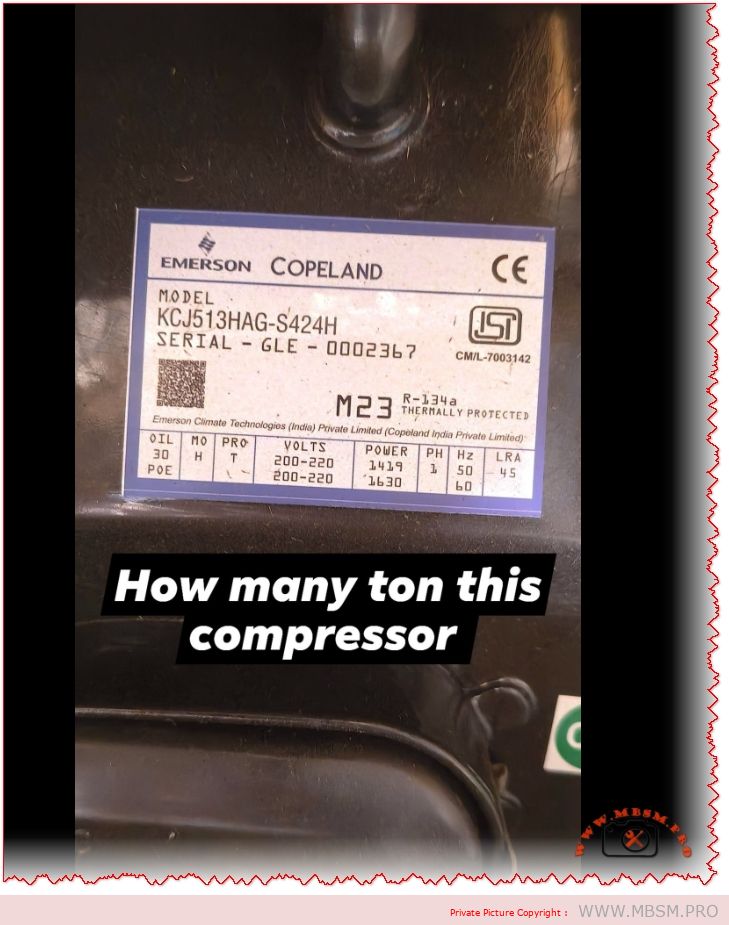
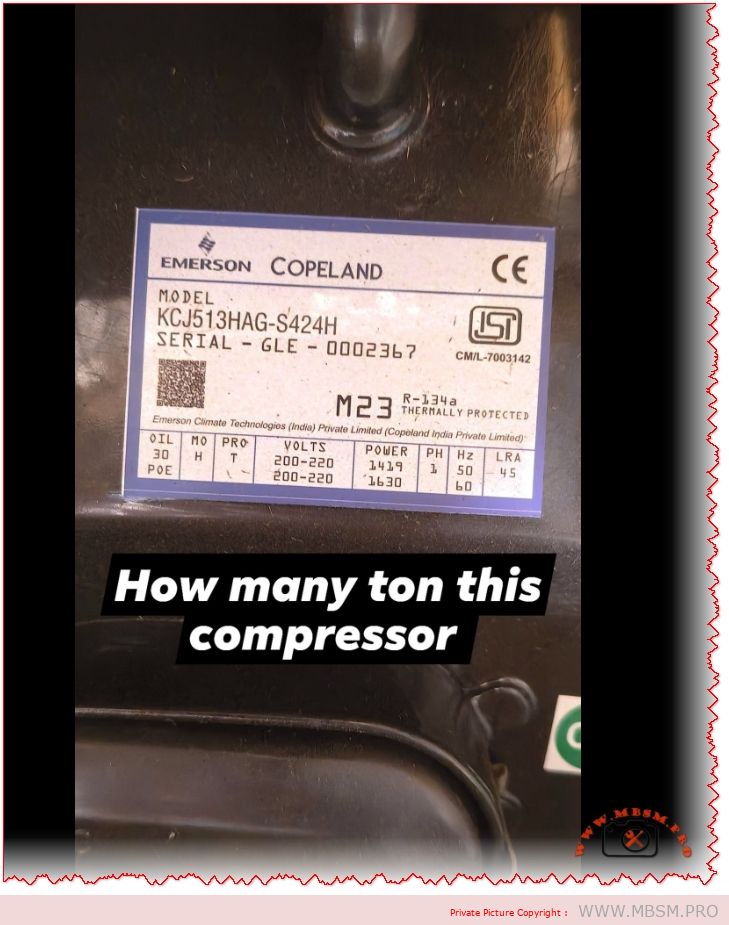
Champion of HBP: Copeland KCJ513HAG-S424H

Mbsmpro.com, Compressor, KCJ513HAG-S424H, 1.2 HP, Copeland, R134a, HBP, 12300 Btu/h, 230V, CSCR, Water Cooler, Air Conditioning


The Heavyweight Champion of HBP: Copeland KCJ513HAG-S424H

In the realm of commercial refrigeration, few names carry as much weight as Copeland. If you are an artisan bricoleur repairing a large water cooler, a bottle chiller, or a specialized air conditioning unit, encountering the KCJ513HAG-S424H means you are dealing with a robust, high-torque machine. This isn’t a small domestic compressor; it is a 1.2 HP beast designed to move heat fast.

The KCJ series (Reciprocating) is legendary for its durability in high-ambient temperatures (common in Tunisia and the Middle East). Unlike rotary compressors that might struggle when the condenser gets clogged with dust, this reciprocating connecting rod design keeps pumping. The “HAG” suffix is your key identifier: ‘H’ stands for High Temperature (HBP), and ‘G’ confirms it is built for R134a gas.

Why 1.2 HP Matters for High Back Pressure (HBP)

This compressor is a “High Back Pressure” specialist. It is designed to operate where the evaporator temperature is relatively high (like +7.2°C for AC or water cooling).

  • Cooling Capacity: At standard ASHRAE conditions, it delivers a massive 12,300 Btu/h (approx 3,604 Watts).
  • Efficiency: It uses a CSCR (Capacitor Start Capacitor Run) motor configuration. This means it has a start capacitor to get the heavy piston moving and a run capacitor to keep the amperage low (approx 6.5 Amps) while running.

Technical Specifications: The Data Sheet

Below is the precise data for the KCJ513HAG-S424H.

Feature Specification
Model KCJ513HAG-S424H
Brand Copeland (Emerson)
Nominal HP 1.20 HP (approx. 1 Ton)
Displacement 38.04 cc/rev
Refrigerant R134a (Tetrafluoroethane)
Application HBP (High Back Pressure) / AC / Heat Pump
Voltage 220-230V ~ 50Hz
Cooling Capacity 12,300 Btu/h (@ +7.2°C Evap)
Input Power 1374 Watts
Input Current 6.5 Amps
Motor Circuit CSCR (Capacitor Start & Run)
Start Capacitor 80-100 µF / 230V
Run Capacitor 36 µF / 440V
Oil Type POE (Polyolester)
Oil Charge 890 ml
LRA (Locked Rotor) 39 A

Comparison: Copeland KCJ513HAG vs. Tecumseh & Danfoss

When this specific Copeland is unavailable, you need a backup plan. Here is how it compares to other market leaders in the 1 HP+ R134a category.

Compressor Brand Nominal HP Displacement Cooling (HBP) Verdict
KCJ513HAG Copeland 1.2 HP 38.0 cc 12,300 Btu Best for rugged, high-vibration environments.
TAG4518Y Tecumseh 1.5 HP 53.2 cc 15,000 Btu Slightly larger; good upgrade if space permits.
CAJ4511Y Tecumseh 1 HP 32.7 cc 10,500 Btu A bit weaker; only use for smaller loads.
MT18 Maneurop 1.5 HP 30.2 cc 13,000 Btu Excellent alternative, but physically larger/heavier.

Exploitation Note: If you replace a rotary compressor with this reciprocating model, ensure you add a liquid receiver. Reciprocating pumps are less tolerant of liquid slugging than rotaries!


Exploitation: Installation & Troubleshooting

For the technician, installing the KCJ513HAG requires attention to detail:

  1. Capacitor Logic: This unit requires the start capacitor to fire. If you hear a “hum” but no start, check the potential relay (AC85001) and the 80-100µF start capacitor. They are the most common failure points, not the compressor itself.
  2. Oil Management: It comes charged with POE oil. If you are retrofitting an old R12 system (rare these days, but possible), you must flush the lines completely. R134a + Mineral Oil = Sludge.
  3. Vibration: This is a heavy piston compressor (~22.5 kg). Ensure the rubber grommets are fresh. If you bolt it down too tight without the rubber play, the vibration will crack the copper discharge line within weeks.
  4. Heat Management: At 54.4°C condensing temp, this unit works hard. Ensure the condenser fan is clean and spinning at full RPM (usually 1300 RPM for these units).

Champion of HBP: Copeland KCJ513HAG-S424H mbsmpro

Focus Keyphrase:

Copeland KCJ513HAG-S424H Compressor Specs R134a

SEO Title:

Mbsmpro.com, Compressor, KCJ513HAG-S424H, 1.2 HP, Copeland, R134a, HBP, 12300 Btu, 230V

Meta Description:

Detailed specs for Copeland KCJ513HAG-S424H (1.2 HP, R134a). Discover cooling capacity, capacitor values (CSCR), and Tecumseh comparisons for water coolers and AC repair.

Slug:

copeland-kcj513hag-s424h-compressor-1-2hp-r134a-specs

Tags:

Mbsmgroup, Mbsm.pro, mbsmpro.com, mbsm, Copeland Compressor, KCJ513HAG, 1.2 HP Compressor, R134a HBP, Commercial Refrigeration, Water Cooler Repair, KCJ513HAG-S424H, Emerson Climate

Excerpt:

The Copeland KCJ513HAG-S424H is a powerhouse 1.2 HP compressor designed for high-demand cooling. Built for R134a applications like large water coolers and AC units, it delivers 12,300 Btu/h reliability. This guide covers its CSCR electrical setup, 38cc displacement, and how it compares to Tecumseh alternatives.


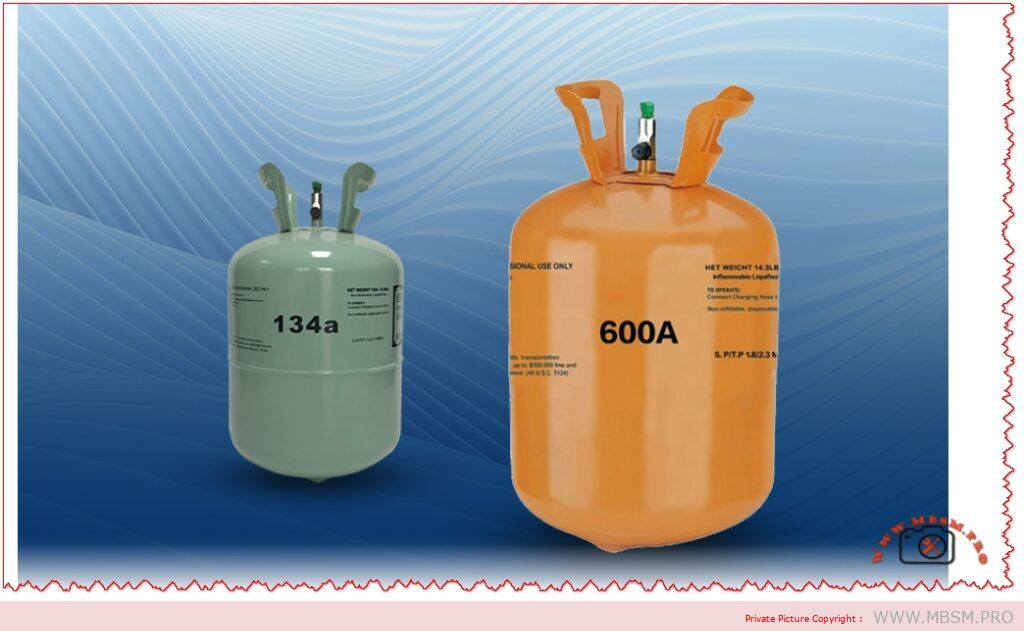
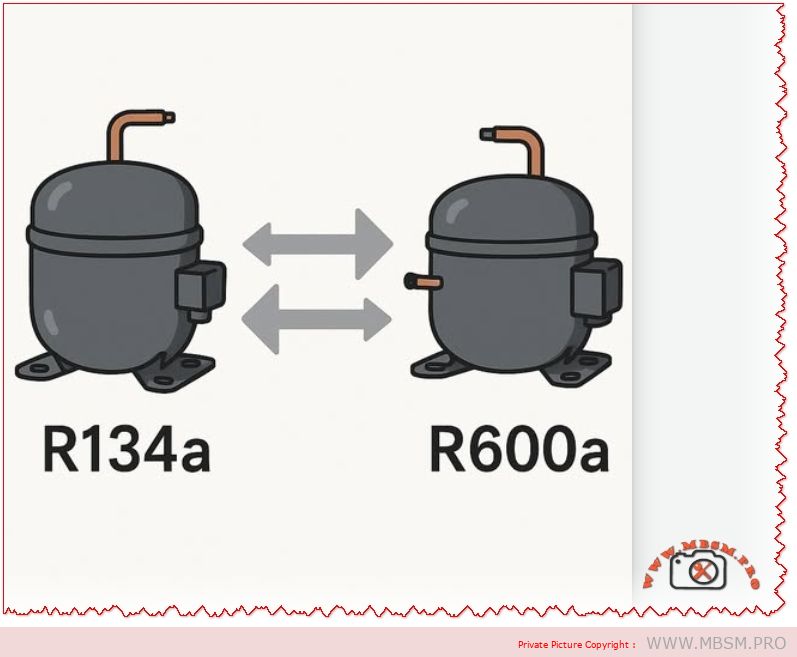
R134a vs. R600a Compressor Conversion

Mbsmpro.com, Comparison, R134a vs R600a, Compressor Retrofit, Displacement Calculation, Capillary Sizing, Refrigeration Repair


The Technician’s Guide: R134a vs. R600a Compressor Conversion

In the evolving world of refrigeration repair, the transition from HFCs (R134a) to Hydrocarbons (R600a) is no longer a choice—it is the standard. For the artisan bricoleur, understanding the relationship between these two refrigerants is critical. You cannot simply swap one for the other without understanding the physics of displacement and pressure.

This guide breaks down exactly what happens when you compare an R134a system to an R600a system, and how to correctly calculate the replacement if you are retrofitting a cabinet (changing the compressor and gas).

The Golden Rule: Displacement is King

The biggest mistake technicians make is matching “Horsepower to Horsepower” (e.g., swapping a 1/5 HP R134a with a 1/5 HP R600a). Do not do this.

R600a gas is much less dense than R134a. To pump the same amount of heat, the R600a compressor must have a larger cylinder volume (displacement).

  • R134a Displacement Factor: 1.0
  • R600a Displacement Factor: ~1.7 to 2.0

If you remove an R134a compressor with a 5.0 cc displacement and replace it with a 5.0 cc R600a compressor, the fridge will never get cold. You need an R600a compressor with approximately 8.5 cc to 10 cc to do the same work.


Technical Comparison: R134a vs R600a

Here is the data you need to understand the behavior of these gases inside your pipes.

Feature R134a (Tetrafluoroethane) R600a (Isobutane) The Difference
Operating Pressure (Low Side) 0 to 2 PSI (Positive pressure) -5 to -10 inHg (Vacuum) R600a often runs in a vacuum. Leaks suck air in.
Displacement Required Low (Dense gas) High (Light gas) R600a compressor needs ~70-80% bigger cylinder.
Charge Amount 100% (Baseline) ~45% of R134a mass If R134a took 100g, R600a takes only ~45g.
Oil Compatibility POE (Polyolester) Mineral or Alkylbenzene R600a is compatible with mineral oil (cheaper/less hydroscopic).
GWP (Global Warming Potential) 1430 (High) 3 (Very Low) R600a is eco-friendly.
Flammability A1 (Non-Flammable) A3 (Highly Flammable) Requires spark-proof tools and care.

Retrofit Table: Equivalent Displacement (Estimated)

Use this table when you are forced to replace a dead R134a compressor with a new R600a model on an existing fridge.

Original R134a Compressor Approx. Displacement Target R600a Compressor Approx. Displacement
1/6 HP 4.0 cc 1/5 HP ~7.0 – 8.0 cc
1/5 HP 5.5 cc 1/4 HP ~9.0 – 10.5 cc
1/4 HP 7.5 cc 1/3 HP ~13.0 – 14.0 cc
1/3 HP 9.0 cc 3/8 HP ~16.0 cc

Note: These are estimations. Always check the Cooling Capacity (Watts) at -23.3°C (LBP) in the datasheet. The Watts must match!


Exploitation: The Capillary Tube & Oil Dilemma

When converting a system designed for R134a to use an R600a compressor, you face two hurdles:

  1. Capillary Tube: R600a has a higher latent heat of vaporization. Ideally, it requires a slightly different restriction than R134a. However, in practice (for repair jobs), the original R134a capillary tube often works “acceptably” because the lower mass flow of R600a balances out with its higher specific volume. Do not shorten the capillary unless you have high superheat issues.
  2. Oil Mixing: R134a systems contain POE oil stuck in the evaporator. R600a compressors come with Mineral oil. While R600a can tolerate some POE, it is best to flush the system with nitrogen and a flushing agent to remove as much old POE oil as possible before brazing the new compressor.

Safety First: Working with Isobutane

  • No Brazing on Charged Systems: Never use a torch if there is any chance of gas in the system. Use tube cutters.
  • Ventilation: R600a is heavier than air. It settles in low spots (floors, inspection pits). Ensure good airflow.
  • Spark-Free: When vacuuming, ensure your pump switch and relay are not sparking sources near the vents.

R134a vs. R600a Compressor Conversion mbsmpro

Focus Keyphrase:

R134a vs R600a Compressor Conversion Comparison

SEO Title:

Mbsmpro.com, Comparison, R134a vs R600a, Compressor Retrofit, Displacement Calculation, Capillary Sizing, 1/5 HP

Meta Description:

Master the R134a to R600a conversion. Learn why displacement ratios matter (1.7x rule), how to calculate charge weight (45%), and essential safety tips for retrofitting fridge compressors.

Slug:

r134a-vs-r600a-compressor-conversion-displacement-guide

Tags:

Mbsmgroup, Mbsm.pro, mbsmpro.com, mbsm, R600a Conversion, R134a Replacement, Compressor Displacement, Fridge Repair, HVAC Retrofit, Isobutane Safety, Capillary Sizing, 1/5 HP Compressor

Excerpt:

Switching from R134a to R600a requires more than just changing the gas. This guide explains the critical “Displacement Rule”—why R600a compressors need nearly double the cylinder volume of R134a units to produce the same cooling. We cover charge calculation (45% rule), oil compatibility, and safety protocols for the modern artisan.


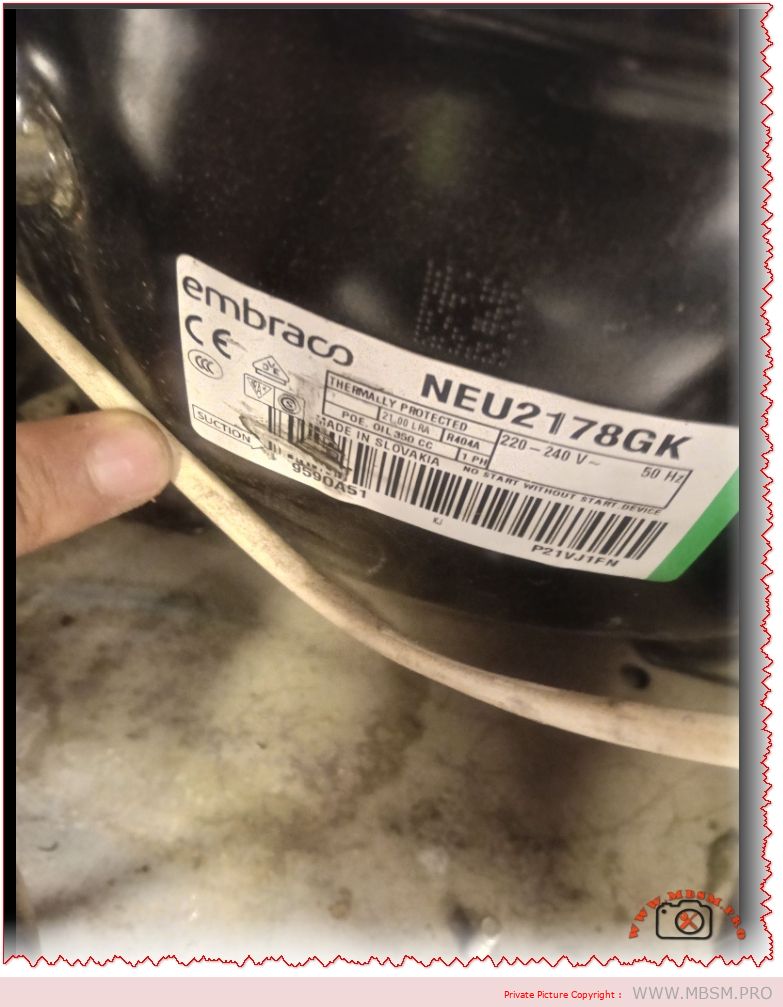
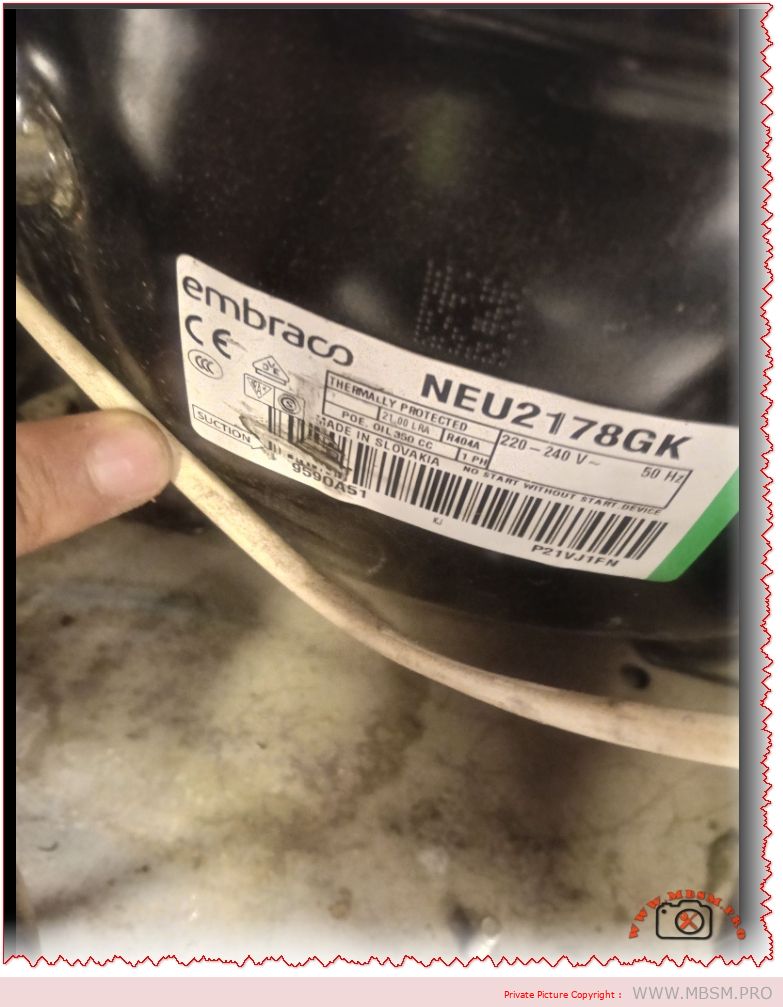
Embraco NEU2178GK, compressor

Mbsmpro.com, Embraco, NEU2178GK, 1 HP, LBP, R404A, 220-240V, 50Hz, 16.8 cc, CSR, Commercial Freezer Compressor


The Cold Heart of Commercial Freezing: Embraco NEU2178GK

If you are an artisan bricoleur or a refrigeration technician working on commercial island freezers or restaurant reach-ins, you have likely encountered the Embraco NEU2178GK. This isn’t your standard domestic fridge compressor; this is a 1 HP powerhouse designed for the heavy lifting required by Low Back Pressure (LBP) applications using R404A or R507 refrigerant.

Known for its robust “Made in Slovakia” build, the NEU2178GK is a CSR (Capacitor Start, Capacitor Run) motor. This is a critical detail for technicians: unlike simpler PTCSCR compressors, this unit relies on a precise electrical box containing both a start capacitor and a run capacitor to manage its high starting torque (HST). It is the engine you choose when you need reliability in a -30°C environment.

Why the “GK” Matters

In Embraco’s nomenclature, the “K” at the end (as in NEU2178GK) often signifies a specific motor type—in this case, one designed for High Starting Torque. This means it can restart even if pressures haven’t fully equalized, a common scenario in busy commercial kitchens where doors are opened frequently.


Technical Specifications: The Data You Need

Here is the breakdown of the technical capabilities of this compressor.

Feature Specification
Model NEU2178GK
Brand Embraco (Nidec)
Horsepower (HP) 1 HP
Displacement 16.80 cm³ (cc)
Refrigerant R404A / R507 / R452A
Application LBP (Low Back Pressure)
Voltage 220-240V ~ 50Hz
Cooling Capacity ~900 W (at -23.3°C ASHRAE)
Motor Type CSR (Capacitor Start & Run)
Start Capacitor 88 – 108 µF / 330V
Run Capacitor 15 µF / 400V
Oil Type POE 22 (Polyolester)
Oil Charge 350 ml
Expansion Device Capillary or TXV (Expansion Valve)

Exploitation: Installation Tips for the Artisan

Installing a 1 HP commercial compressor is different from swapping a domestic one. Here are the “golden rules” for the NEU2178GK:

  1. The Electric Box is Mandatory: You cannot bypass the capacitor box. This motor needs the 15µF run capacitor to maintain efficiency and keep the windings cool, and the start capacitor to kick the rotor into motion against high head pressure.
  2. Moisture is the Enemy: This compressor comes filled with POE oil. POE is like a sponge for humidity. If you leave the plugs open for more than 15 minutes, the oil absorbs moisture that vacuum pumps cannot remove. Keep it sealed until the last second.
  3. Nitrogen Sweep: Because R404A systems use POE oil, any carbon from brazing will turn into sludge and block the capillary tube immediately. Always braze with a trickle of nitrogen flowing through the pipes.
  4. R452A Compatibility: If R404A is expensive or restricted in your area, this compressor is often compatible with R452A, a drop-in replacement with a lower GWP (Global Warming Potential), but always check the discharge temperature.

Comparison: Embraco NEU2178GK vs. The Competition

When you can’t find the exact Embraco model, you need a replacement. Here is how it stacks up against the heavyweights from Secop and Tecumseh.

Compressor Brand Approx. HP Displacement Verdict
NEU2178GK Embraco 1 HP 16.8 cc Best for high-torque commercial freezers.
SC21CL Secop (Danfoss) ~7/8 – 1 HP 20.95 cc Older design, physically larger, very reliable.
CAJ2464Z Tecumseh 1.5 HP 34.4 cc Much more powerful; usually overkill for this slot.
NT2180GK Embraco 1 HP 20.4 cc The “big brother” of the NEU series; fits if you have space.

Pro Tip: If replacing a Secop SC21CL with this Embraco NEU2178GK, you may need to adjust the pipework as the Embraco is slightly more compact (lower height: ~206mm vs Secop ~219mm).


Performance Analysis: Power Consumption

One reason technicians love the NEU series is efficiency.

  • Current (Amps): At typical freezer conditions (-25°C), it draws about 4.3 Amps.
  • LRA (Locked Rotor Amps): 21.0 A. If your clamp meter reads 21A instantly and stays there, your compressor is mechanically seized or the start capacitor is dead.

Performance Analysis: Power Consumption

One reason technicians love the NEU series is efficiency.

  • Current (Amps): At typical freezer conditions (-25°C), it draws about 4.3 Amps.
  • LRA (Locked Rotor Amps): 21.0 A. If your clamp meter reads 21A instantly and stays there, your compressor is mechanically seized or the start capacitor is dead.

Embraco NEU2178GK, compressor mbsmpro

Focus Keyphrase: Embraco NEU2178GK 1 HP Compressor R404A

SEO Title: Mbsmpro.com, Embraco, NEU2178GK, 1 HP, LBP, R404A, 220-240V, 50Hz, 16.8 cc, CSR, Commercial Freezer

Meta Description: Discover the Embraco NEU2178GK 1 HP Compressor (R404A/LBP). Full technical specs, CSR wiring guide, and comparisons with Secop and Tecumseh for commercial refrigeration repairs.

Slug: embraco-neu2178gk-1-hp-compressor-r404a-lbp-specs

Tags: Mbsmgroup, Mbsm.pro, mbsmpro.com, mbsm, Embraco NEU2178GK, 1 HP Compressor, R404A, Commercial Freezer, CSR Motor, NEU2178GK Specs, Refrigeration Repair, 16.8cc Compressor

Excerpt: The Embraco NEU2178GK is the definitive choice for 1 HP commercial freezing applications. Featuring a robust CSR motor and 16.8cc displacement, this R404A compressor delivers high starting torque for demanding environments. This guide details the electrical requirements, installation tips, and how it compares to Secop and Tecumseh alternatives.


Fitco Wired & Wireless Smart Kit

Mbsmpro.com, Fitco, Wired Controller, Remote Kit, WiFi Smart Module, M+7*1600(SY), Universal AC Control, 12V/24V, HVAC Upgrade, Smart Life App, Split System, VRF


The Ultimate HVAC Command Center: Fitco Wired & Wireless Smart Kit

In the world of air conditioning maintenance, control is everything. Whether you are an HVAC technician diagnosing a fault or a homeowner tired of losing the remote, the Fitco Smart Control Kit represents the perfect bridge between reliability and modern technology. This comprehensive system is not just a spare part; it is an upgrade that transforms a standard split system into a smart, fully manageable climate station.

This kit is unique because it offers triple redundancy: a wall-mounted wired thermostat for permanent access, a handheld wireless remote for convenience, and a WiFi module to bridge your cooling system to the cloud. For the artisan bricoleur, this means fewer callbacks for “lost remotes” and easier diagnostics via the wired interface.

Why “Wired” Still Matters in a Wireless World

You might ask, “Why install a wired controller when I have a phone?” The answer is reliability. Wireless signals can fail, batteries die, and phones get lost. A wired controller like the Fitco M+7 Series is hardwired directly to the indoor unit’s PCB. It communicates via a stable data signal (often 0-5V or 12V), ensuring that when you press “Cool,” the compressor engages every time.

Moreover, for commercial applications—like offices or server rooms—a wall-mounted controller prevents employees from losing the remote or setting dangerous temperatures, as many wired units feature “Admin Lock” capabilities.


Technical Specifications & Capabilities

Below is the technical breakdown of the Fitco Control System.

Feature Specification
Model Series Fitco M+7*1600(SY)
Control Type Hybrid (Wired + IR Wireless + WiFi)
Input Voltage 5V DC / 12V DC (Powered via Indoor Unit PCB)
Communication 3-Wire / 4-Wire Shielded Data Cable
WiFi Frequency 2.4 GHz (802.11 b/g/n)
App Compatibility Smart Life, Tuya, Brand Specific
Functions Mode (Cool/Heat/Dry/Fan), Swing, Timer, Sleep, Turbo
Display LCD Backlit (Wired Unit)
Installation Wall-Mount (Standard Electrical Box spacing)
Compatibility Universal Split, Cassette, Duct, VRF Systems

Comparison: Fitco Hybrid Kit vs. Standard Remotes

To understand the value of this upgrade, we compare it against standard solutions found in the market.

Criterion Standard IR Remote Fitco Hybrid Kit (Wired+WiFi) Verdict
Reliability Low (Line of sight required) High (Direct Wire + Cloud) Fitco wins for critical cooling.
Placement Loose / Tabletop Fixed Wall Mount Never lose your controller again.
Diagnostics None (Blind operation) Error Code Display Essential for troubleshooting faults.
Smart Features None Global App Control Turn on AC before you arrive home.
Installation Instant Requires Wiring Professional installation recommended.

Tech Note: The inclusion of the WiFi dongle (often a USB or 4-pin header stick) allows the AC to communicate with servers. This means you can integrate your “dumb” AC into Google Home or Amazon Alexa ecosystems without buying a new unit.


Installation Guide: The “Artisan” Approach

Warning: Always disconnect main power before opening the indoor unit.

  1. Locate the PCB Port: Open the front panel of the indoor unit and locate the mainboard. Look for a socket labeled “DISP,” “WIRE_CON,” or “CN40.”
  2. Run the Cable: Fish the shielded 4-core cable from the indoor unit through the wall to the desired thermostat location. Avoid running this parallel to high-voltage (220V) power lines to prevent signal interference.
  3. Mount the Backplate: The Fitco controller separates from its base. Screw the base plate into the wall or switch box.
  4. Connect & Test: Connect the harness. Power up the breaker. The wired controller should light up immediately. If it displays an “E1” or “Communication Error,” check your A/B signal wire polarity.
  5. WiFi Setup: Plug the white Smart Module into the specific USB/Header port on the indoor unit (or the wired controller, depending on model). Scan the QR code to pair with your smartphone.

The “Smart” Advantage: Energy Efficiency

One of the hidden benefits of the Fitco Smart Kit is energy monitoring. Unlike a simple thermostat that just clicks on and off, this intelligent system can often track runtime. By using the “Timer” and “Sleep” algorithms effectively via the app, users typically see a reduction in electricity usage by preventing the AC from running efficiently in empty rooms.

For the refrigeration technician, this kit is a high-value upsell. You are not just repairing an AC; you are modernizing it.


Fitco Wired & Wireless Smart Kit mbsmpro

Focus Keyphrase:

Fitco AC Wired Controller Remote Kit WiFi

SEO Title:

Mbsmpro.com, Fitco AC Wired Controller, Remote Kit, WiFi Ready, Smart HVAC Control, Universal Split AC, Thermostat Upgrade

Meta Description:

Upgrade your HVAC with the Fitco AC Wired Controller & WiFi Kit. Features dual-interface control, Smart Life app compatibility, and universal split system integration. Perfect for technicians.

Slug:

fitco-ac-wired-controller-remote-kit-wifi-smart-hvac

Tags:

Mbsmgroup, Mbsm.pro, mbsmpro.com, mbsm, Fitco Controller, Wired Thermostat, HVAC Smart Kit, Universal AC Remote, WiFi AC Module, Split Air Conditioner, VRF Control, Technician Tools

Excerpt:

The Fitco Wired & Wireless Controller Kit is the ultimate upgrade for any split air conditioning system. Combining the reliability of a hardwired wall thermostat with the convenience of WiFi smart control, this kit ensures you never lose command of your climate. Ideal for offices, homes, and server rooms requiring redundant cooling management.