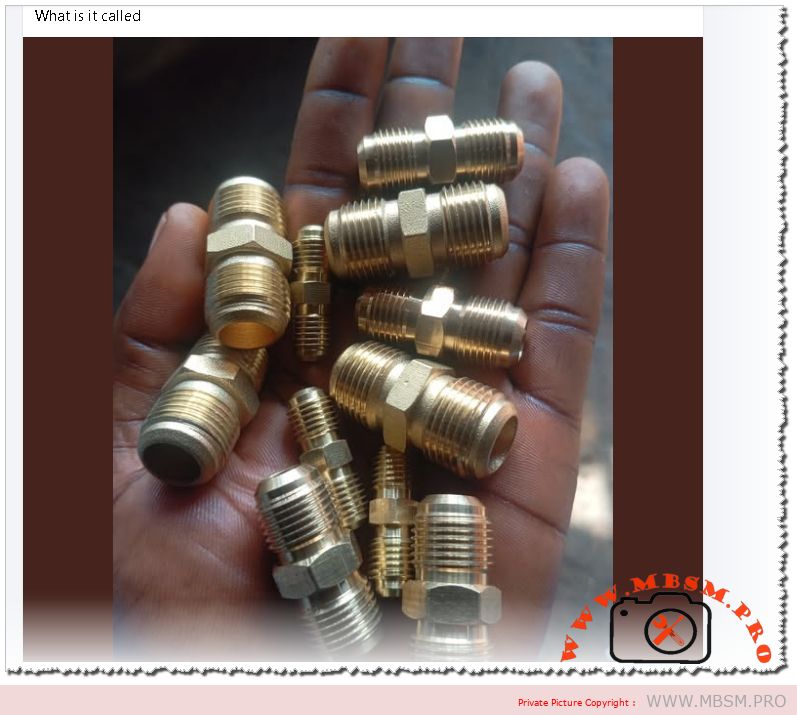
Brass Male Flare Union Fittings for Refrigeration and HVAC Systems
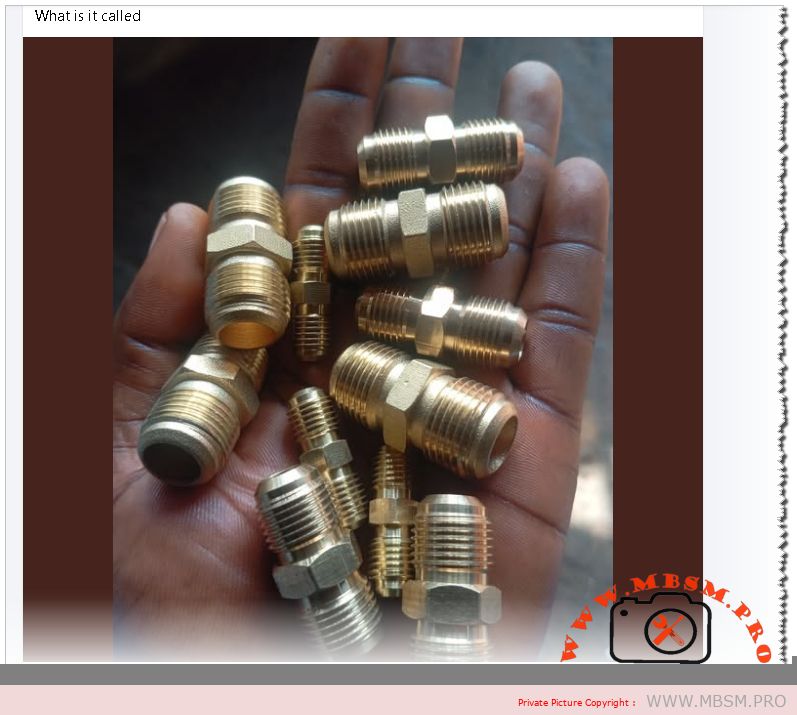
Brass Male Flare Union Fittings for Refrigeration and HVAC Systems

Brass male flare unions are precision fittings used to connect two flared copper or aluminum tubes in refrigeration, air‑conditioning, and gas lines without brazing or welding. These fittings are standard components in professional HVAC installations and service operations.​


What These Fittings Are Called

In professional catalogs and engineering documentation, the parts in the image correspond to:

  • Brass male‑to‑male flare union
  • Brass flare straight union
  • Brass flare adapter or half‑union (for versions with a different thread or one closed end)
  • SAE 45° brass flare fittings, typically conforming to SAE J512/J513 for refrigeration and gas service.​

These fittings are commonly listed with sizes such as 1/4″, 3/8″, or 1/2″ male flare, and are compatible with flared copper, brass, aluminum, or steel tubing in HVAC and refrigeration circuits.​


Technical Function and Engineering Advantages

Brass male flare unions provide a mechanical seal between two flared tubes, using metal‑to‑metal contact and the clamping force of the nut. This sealing method avoids filler metals and high temperatures, which is especially useful for:​

  • Connecting service hoses and gauges to refrigeration lines
  • Extending or repairing capillary tubes and liquid lines
  • Creating demountable joints in areas where future disassembly is expected

Engineering advantages include:

  • Good corrosion resistance in refrigerant and oil environments, thanks to C360/C370 brass alloys.​
  • Wide working temperature range, typically from −65 °F to +250 °F, suitable for standard HVAC refrigerants.​
  • Adequate working pressures for common refrigeration tubing; allowable pressure depends on tube material, wall thickness, and outside diameter.​

Typical Applications in HVAC/R

These fittings are standard in:

  • Refrigeration condensing units and cold rooms using copper linesets
  • Split AC systems where service valves and gauge manifolds connect via flare unions
  • Gas lines and hydraulic circuits using flared metal tubing, where leak‑tight mechanical joints are required.​

They are especially popular in light commercial and domestic refrigeration where technicians want a reversible connection during commissioning, pressure testing, or component replacement.​


Comparison With Other HVAC Fittings

Common HVAC Tube Fittings Overview

Fitting type Assembly method Typical use in HVAC/R Reusability Need for flame
Brass male flare union Flare and tighten nut Join two flared copper tubes or extend lines High No
Solder/brazed coupling Heat and filler metal Permanent joints in copper liquid/suction lines Low Yes
Compression fitting Ferrule compression Water lines and some low‑pressure services Medium No
Flare‑to‑pipe adapter Flare + NPT/BSP thread Transition between flared tubing and threaded components High No

Flare unions are preferred where disassembly, leak testing, or component replacement will be routine, while brazed couplings are chosen for long‑term permanent joints in inaccessible locations.​


Professional Installation Guidelines and Best Practices

For reliable performance and to meet professional HVAC standards:

  • Use properly sized flaring tools with a 45° flare angle compatible with SAE flare fittings.​
  • Ensure the tubing end is cut square, deburred, and cleaned before flaring to avoid scoring the sealing surface.
  • Lubricate threads lightly with refrigeration oil and tighten to the manufacturer’s recommended torque to prevent both under‑tightening (leaks) and over‑tightening (cracked flares).
  • Avoid mixing metric and imperial flare sizes or different thread standards; always match the fitting spec to the tubing and equipment rating.​

For critical circuits using high‑pressure refrigerants, consult the pressure rating tables in the manufacturer’s catalog and verify compatibility with the working and test pressures of the system.​


Practical Tips for Technicians and Engineers

Some additional professional conseils for field and design use:

  • When designing new lines, minimize the number of mechanical joints; use flare unions mainly for service points or where components must be removable.
  • During retrofits, replace damaged or rounded flare nuts; re‑using deformed nuts increases leak risk even if the tubing flare is renewed.​
  • In vibration‑prone locations (compressor discharge lines, mobile refrigeration), support the tubing near flare unions with proper clamps to reduce stress on the joint.
  • Always perform nitrogen pressure tests and vacuum leak checks after installing or re‑tightening flare unions to confirm system integrity.​

Focus Keyphrase for Yoast SEO

Focus keyphrase:
Brass male flare union fitting for refrigeration and HVAC copper tubing connections, SAE 45 degree brass flare connector for air conditioning and gas lines


SEO Title

SEO title:
Brass Male Flare Union Fittings for Refrigeration and HVAC | Mbsm.pro Technical Guide


Meta Description

Meta description:
Professional guide to brass male flare union fittings for refrigeration and HVAC systems, explaining function, applications, engineering specs, and best installation practices for reliable, leak‑tight copper tube connections.


Slug

Slug:
brass-male-flare-union-refrigeration-hvac


Tags

Tags:
Brass male flare union, flare union fitting, refrigeration flare connector, HVAC brass fittings, SAE 45 flare, copper tube union, gas line flare fitting, Mbsmgroup, Mbsm.pro, mbsmpro.com, mbsm


Excerpt (first 55 words)

Brass male flare union fittings are essential components in refrigeration and HVAC systems, providing reliable mechanical connections between flared copper tubes without the need for brazing. These brass flare unions support a wide operating temperature range and are widely used for service connections, line extensions, and removable joints in air‑conditioning and refrigeration installations.


PDF Catalogs and Technical Documents About Brass Flare Fittings

  • ROBO‑FIT brass flare fittings catalog (technical data and pressure tables)
  • Viking Instrument “Flare Fittings – The World Standard” catalog (HVAC and gas applications)
  • Refrigeration Supplies Distributor brass flare fittings section with technical specs (downloadable pages often as PDF from category)
  • Refrigerative Supply brass fittings catalog pages (brass flare connectors for HVAC)
  • AC Pro Store copper and brass fittings documentation for HVAC, including brass flare fittings
  • JB Industries brass fittings documentation for unions and adapters used in refrigeration service
  • Mueller Streamline brass flare fittings literature, commonly linked as PDF from distributor pages like Refrigerative Supply
  • Fairview Fittings brass flare and pipe adapters technical catalog, accessible via distributor product pages
  • AWH refrigeration brass male flare union product data from manufacturer listing on Alibaba (technical attributes and application field HVAC system)
  • General brass flare fitting installation and application guides included in many HVAC training documents and manufacturer catalogs referenced above, especially Viking Instrument and ROBO‑FIT.​
Brass Male Flare Union Fittings for Refrigeration and HVAC Systems mbsmpro
Brass male flare union, copper tube union, flare union fitting, gas line flare fitting, HVAC brass fittings, mbsm.pro, mbsmgroup, mbsmpro.com, refrigeration flare connector, SAE 45 flare


Key HVAC full forms

Mbsmpro.com, HVAC Abbreviations, HVAC, AHU, FCU, CSU, PAC, BTU, PSI, TR, VAV, VRV, VRF, RPM, DC, DB, ACB

Key HVAC full forms

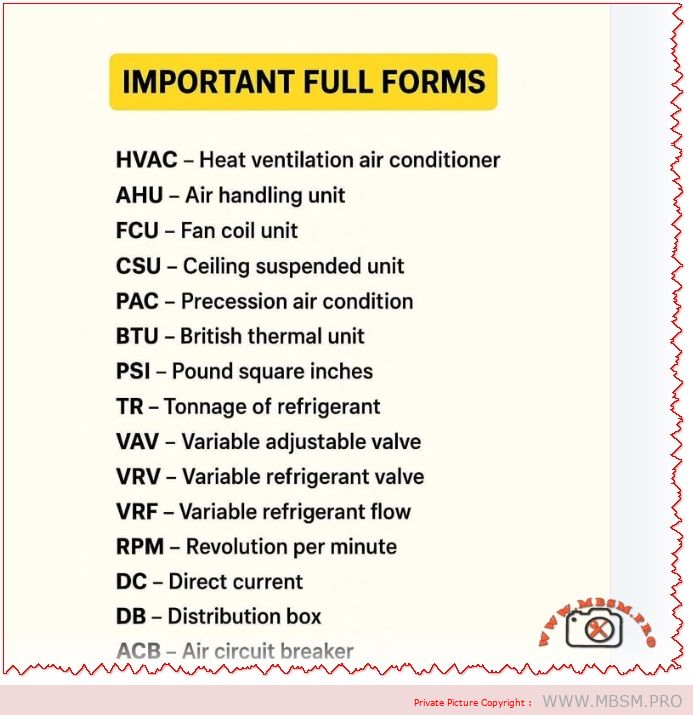
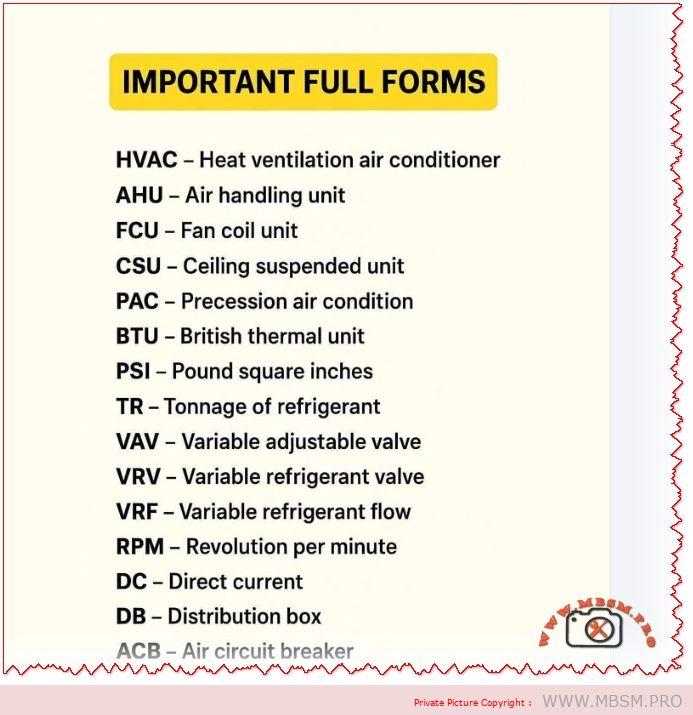
In daily HVAC practice, technicians use many abbreviations that can confuse beginners and even young engineers. Below is a corrected, standards‑based list of the most common terms and what they really mean.

Abbreviation Correct full form Technical note
HVAC Heating, Ventilation and Air Conditioning General term for comfort and process air‑conditioning systems.
AHU Air Handling Unit Central unit with fan, filters and coils that conditions and distributes air through ductwork.
FCU Fan Coil Unit Small terminal unit with fan and coil, usually serving a single room or zone.
CSU Ceiling Suspended Unit (often a type of fan coil or cassette) Manufacturer term; not standardised like AHU/FCU but widely used in catalogs. 
PAC Precision Air Conditioner High‑accuracy unit for data centers, labs and telecom rooms, with tight temperature and humidity control.
BTU British Thermal Unit Heat quantity needed to raise 1 lb of water by 1 °F; 1 refrigeration ton = 12 000 BTU/h.
PSI Pounds per Square Inch Pressure unit for refrigerants, water and air in piping and vessels.
TR / Ton Ton of Refrigeration Cooling capacity of 12 000 BTU/h, roughly 3.517 kW, used to size chillers and package units.
VAV Variable Air Volume Air‑distribution system that keeps supply temperature almost constant while varying airflow to each zone.
VRV Variable Refrigerant Volume (Daikin trade name) Brand name for multi‑split systems using variable refrigerant flow technology.
VRF Variable Refrigerant Flow Generic term for inverter‑driven multi‑split systems that modulate refrigerant flow to many indoor units.
RPM Revolutions per Minute Rotational speed of motors, fans and compressors.
DC Direct Current Unidirectional electric current used in ECM fan motors, inverter drives and controls.
DB Dry‑Bulb (temperature) or Distribution Board (electrical) In HVAC drawings DB usually means dry‑bulb temperature; in electrical layouts, it means distribution board.
ACB Air Circuit Breaker High‑capacity protective device used in main LV switchboards feeding large HVAC plants.

These definitions correct several mistakes often seen on social media, such as “Heat ventilation air conditioner” for HVAC or “Pound square inches” for PSI, which are not accepted engineering terms.


How these terms work in real projects

Understanding the context of each abbreviation is essential when reading specifications or troubleshooting systems on site.

  • HVAC vs PAC

    • HVAC usually refers to comfort systems for offices, homes and shops, with temperature bands around 22–26 °C and moderate humidity control.
    • PAC targets critical rooms, maintaining about ±1 °C and tight humidity to protect IT or laboratory equipment, often running 24/7 with redundancy.

  • AHU, FCU and CSU in a building

    • An AHU supplies large zones via ducts, while FCUs or CSUs act as terminal units in rooms where local control and compact installation are required.
    • Designers often combine one AHU with many FCUs/CSUs to balance fresh air quality, energy efficiency and individual comfort.

  • Tonnage (TR) and BTU in equipment selection

    • Manufacturers still rate split and rooftop units in BTU/h for the global market, while consultants size plants in tons or kW, so technicians must convert between units quickly.
    • On residential projects, 1–2 ton units dominate, while data centers or malls may require hundreds of tons on central chillers or VRF networks.


Comparing VAV, VRF and traditional systems

Many designers now face a practical choice between classic VAV ducted systems and newer VRF/VRV systems. Below is a concise comparison that can help technicians justify selections to clients.

System comparison in practice

Feature VAV system VRF / VRV system Conventional constant‑volume DX
Energy control Varies air volume with nearly constant supply temperature. Varies refrigerant flow using inverter compressors. Fixed compressor and constant airflow, controlled by on/off cycling.
Ductwork Requires extensive ducts, plenums, and balancing dampers. Often ductless or with short ducts from indoor units. Medium ductwork, usually single‑zone per unit.
Indoor units VAV boxes with reheat coils or dampers at zones. Multiple indoor fan coils (wall, cassette, ducted, ceiling suspended). One indoor unit per outdoor condenser.
Best applications Large open‑plan offices, hospitals, airports with central plant. Mixed‑use buildings, hotels, retrofits where duct space is limited. Small shops, houses, standalone rooms.

From a maintenance viewpoint, VRF/VRV brings more electronic controls and refrigerant circuitry, while VAV focuses on dampers, actuators and good air‑side balancing.


Typical values and practical examples

To make these abbreviations more concrete for field technicians, the table below summarizes indicative values that are often encountered in manuals and commissioning reports.

Parameter Typical range / example Where it is used
TR (Ton of Refrigeration) Small split: 1–2 TR, VRF module: 8–20 TR, chiller: 50–500+ TR. Cooling capacity on nameplates, load calculations.
PAC room set‑point 22–24 °C, 45–55% RH, tolerance ±1 °C. Data centers, telecom shelters, medical labs.
VAV supply air temp About 12–14 °C constant; airflow modulates with load. AHU discharge in variable air volume systems.
VRF evaporating temp Usually −5 to +10 °C depending on mode and design. Service data on outdoor units.
Fan / motor RPM 900–1 400 RPM for large AHU fans, 2 800–3 600 RPM for small compressors. Motor nameplates, balancing reports.
Common refrigerant pressures R410A suction: 110–145 PSI, discharge: 350–450 PSI in cooling at comfort conditions (approximate). Gauge readings when interpreting PSI in service.

Knowing these values helps technicians quickly judge whether measured TR, PSI, RPM or temperature readings are normal or indicate faults.


Why accurate full forms matter for SEO and training

Correct terminology is not only important on drawings and control panels; it also has direct impact on SEO and on how junior technicians learn from the web. When HVAC blogs repeat wrong expansions like “Precession air condition” for PAC or “Variable refrigerant valve” for VRV, they create confusion and may even mislead search engines.

For a site such as Mbsmpro.com, using standard full forms aligned with ASHRAE‑style abbreviation lists increases topical authority and helps rank for professional queries like “HVAC abbreviations BTU PSI TR” or “difference between VRF and VAV”.


Key HVAC full forms mbsmpro

Focus keyphrase

HVAC abbreviations full forms HVAC AHU FCU CSU PAC BTU PSI TR VAV VRV VRF RPM DC DB ACB


SEO title

HVAC Abbreviations Explained: HVAC, AHU, FCU, PAC, BTU, PSI, TR, VAV, VRV, VRF, RPM, DC, DB, ACB | Mbsmpro.com


Meta description

Learn the correct full forms of key HVAC abbreviations such as HVAC, AHU, FCU, PAC, BTU, PSI, TR, VAV, VRV, VRF, RPM, DC, DB and ACB, with practical examples and system comparisons for technicians and engineers.


Slug

hvac-abbreviations-full-forms-hvac-ahu-fcu-pac-btu-psi-tr-vav-vrv-vrf-rpm-dc-db-acb


Tags for WordPress

HVAC abbreviations, HVAC full forms, HVAC, AHU, FCU, PAC, BTU, PSI, TR, VAV, VRV, VRF, RPM, Direct current, Dry bulb temperature, Air handling unit, Fan coil unit, Precision air conditioner, Variable refrigerant flow, Variable air volume, refrigeration ton, Mbsmgroup, Mbsm.pro, mbsmpro.com, mbsm


Excerpt (first 55 words)

In daily HVAC practice, technicians use many abbreviations that can confuse beginners and even young engineers. This article explains the most important HVAC abbreviations and their correct full forms, including HVAC, AHU, FCU, PAC, BTU, PSI, TR, VAV, VRV, VRF, RPM, DC, DB and ACB, with practical notes for real projects.


FRIGo TECH ENERGY

Specialists in installation, maintenance, and repair of cooling and freezing rooms, central air conditioning and split systems, control panels of all types, factory chillers of all kinds, and hotel and restaurant equipment. Contact us at 01287772722.

Www.mbsppro.com Informations Pub

Phone: 01287772722


Hello world!

Welcome to mbsmpro.com, your new go-to destination for insightful content and the latest updates in technology, lifestyle, and more!

We’re thrilled to launch this site where you’ll find a variety of articles, tips, and resources designed to inform and inspire. Whether you’re here to explore the newest trends, discover practical advice, or simply stay connected to the world around you, mbsmpro.com aims to be your trusted companion.

Our team is committed to delivering quality content regularly, covering topics that matter to you. We also host a platform for advertisements that support keeping this site free and vibrant.

Stay tuned for exciting posts coming soon, and don’t hesitate to reach out or share your thoughts with us. Thank you for joining us from day one—let’s embark on this journey together!

Welcome aboard to mbsmpro.com!